Several airlines have recently made decisions that look puzzling from the outside. Singapore Airlines just pushed back its next-generation business-class seats by nearly a year. Similar delays have affected several other airlines.
Lufthansa spent much of 2025 flying brand-new aircraft with most of the business-class cabin physically blocked. American Airlines took delivery of a long-awaited aircraft and left it parked in Europe, unable to carry passengers. Air India pushed back a cabin retrofit program by more than a year.
These are not separate incidents. They are symptoms of the same problem, one that sits deep in the aviation supply chain. In this article, we will explain what is actually going on and why it keeps happening across the industry.
Read in this post:
Why modern seats are hard to build

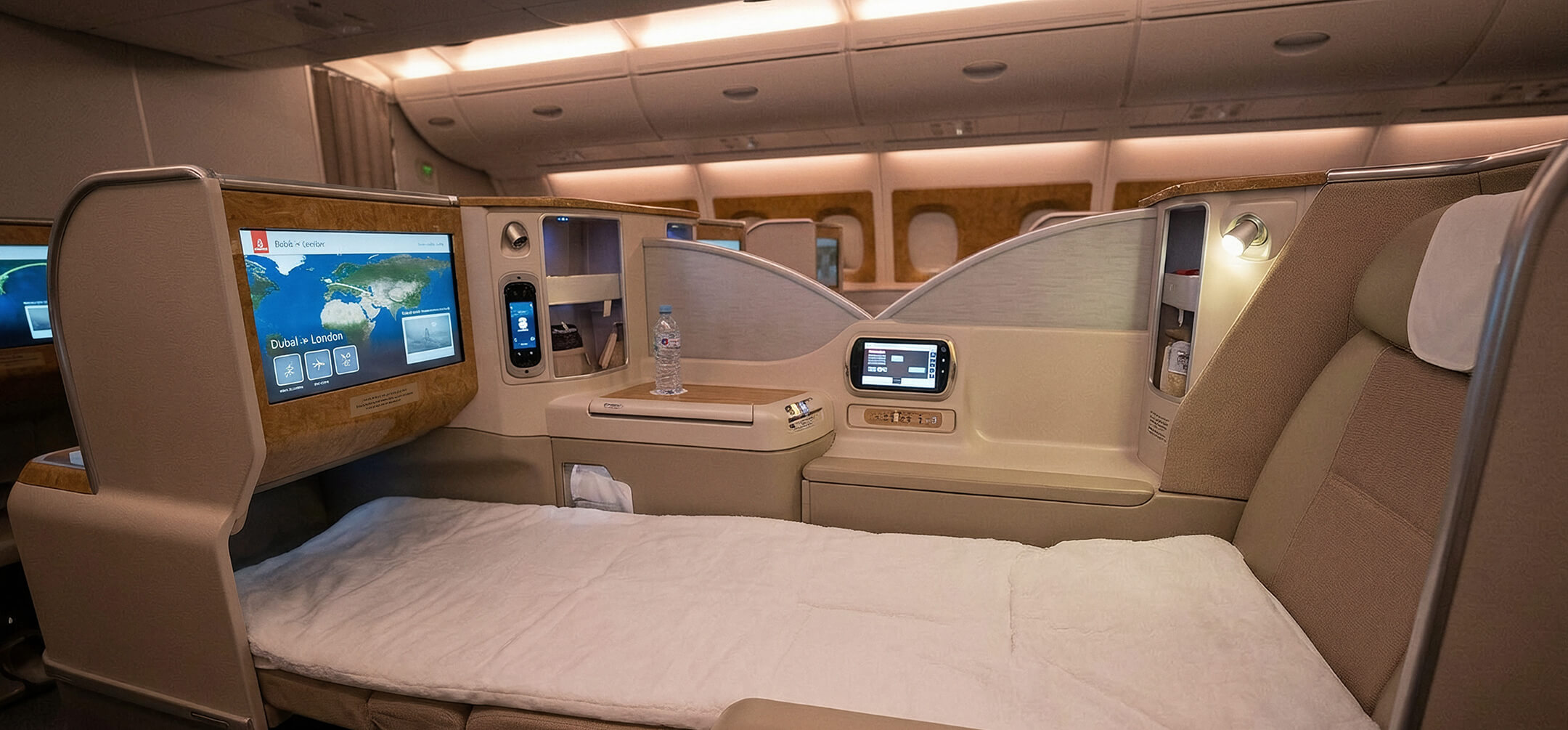
Today’s business-class seat is far more complex than the products airlines installed fifteen years ago. Three factors make it one of the hardest components in aviation to manufacture at scale.
- Design complexity: New seats combine a motorized recline-and-bed mechanism with a privacy door or fixed shell, an integrated 4K screen, power outlets and USB ports, and a table for dining or working. None of these components is interchangeable across aircraft types or airlines that use the same base seat model. Every configuration is a new engineering problem. In total, a business-class seat can involve over 2,000 parts, sourced from multiple manufacturers worldwide.
- Weight constraints: Every pound added to the cabin reduces fuel efficiency. A full long-haul business-class cabin of 30–40 seats adds several tons to the aircraft. Airlines, therefore, engineer every component to be as light as possible, which means seat parts are custom-built to precise specifications.
The German seat manufacturer Recaro, for example, builds its R7 business-class seat to weigh only 176 pounds (80 kg). Airlines cannot substitute seat parts with some from other suppliers without disrupting that balance.
Thus, this combination of complexity, low weight limits, and strict specifications makes manufacturing delays hard to recover from.
How certification slows seat rollouts

Manufacturing the seat is only one part of the problem. Before the airline can use it, regulators must approve the seat for the exact aircraft type and cabin layout where it will fly.
Under both Federal Aviation Administration (FAA) and European Union Aviation Safety Agency (EASA) standards, each seat must pass a series of physical tests before it can carry passengers:
- Dynamic impact tests that simulate emergency landing forces using crash sleds and instrumented test dummies
- Structural load tests that verify if the seat and its mounting system hold together under certain landing forces
- Occupant safety evaluations that confirm the seat can protect the passenger’s head and spine from injuries
- Evacuation clearances that check if the seat may deform in ways that would block cabin evacuation
A seat does not receive a single approval that covers all aircraft. Each seat type must be certified separately for each aircraft type it will be installed on. This is because the floor structure, attachment points, and emergency exit geometry all differ between aircraft.
The Singapore Airlines case

The Singapore Airlines delay is one of the most recent examples of how the seat crisis affects airlines. In 2024, Singapore Airlines invested S$1.1 billion (over US$861 million) to retrofit 41 Airbus A350-900 aircraft with entirely new cabins. The first retrofitted aircraft was scheduled to enter service in the second quarter of 2026. It was now pushed to early 2027.
- What is being delayed: The new business class uses a 1-2-1 forward-facing layout with direct aisle access for every passenger and individual sliding privacy doors, neither of which the current cabin, in service for over 14 years, provides. The new seat is based on the Safran Unity model, already flying on Japan Airlines’ Airbus A350-1000 aircraft. That seat needed to be certified for a different aircraft type, and that is where the delay started.
- How the program reached this point: The seats were originally designed for Singapore Airlines’ Boeing 777-9 planes, with a planned entry into service in 2021. Boeing’s repeated delays of the 777X program forced Singapore Airlines to redirect to the Airbus A350-900 fleet. The certification timeline reset, and the program ran into the same supply chain pressures affecting the rest of the industry.
The Lufthansa case

Lufthansa is also one of the airlines that faced serious issues because of seat certification procedures. This is because the airline’s Allegris business-class cabin on Boeing 787-9 Dreamliner planes was designed with seats from three different manufacturers. The FAA required separate certification for each seat type and also required additional testing of the Collins Aerospace-made seat. This is what happened as a result:
- In August 2025, only 4 of the 28 business-class seats on each aircraft had received FAA clearance. The other 24 were physically installed but blocked from use.
- The airline operated brand-new aircraft with 85% of seats unavailable, which meant a considerable revenue loss.
- The situation persisted until March 2026, when the FAA cleared 25 of the 28 seats. As of May 2026, the three seats in the second row remain blocked.
The same seat, already certified and flying passengers on Lufthansa’s Airbus A350-900, had to go through the entire process again for a different aircraft and only partially passed.
A pattern across the industry

The Singapore Airlines delay is the most recent headline, but the aviation industry has been dealing with such delays for many years now, including throughout 2024 and 2025.
- American Airlines took delivery of its first Airbus A321XLR plane in July 2025, and then left it parked in the Czech Republic because the custom business-class seats had not arrived. The jet, fully certified and ready to fly, sat in storage until October, waiting for its cabin.
When the aircraft eventually entered service, a new problem surfaced: the suite doors on the Flagship Suite could not close because they were still awaiting FAA certification. As a result, the airline began compensating affected business-class passengers with 5,000 AAdvantage miles per flight.
- Delta Air Lines is also facing a long cabin certification delay. The airline ordered 21 Airbus A321neo aircraft in a premium configuration featuring 16 lie-flat Delta One suites. The first jets were delivered in late 2024, but the flat-bed version will not fly until 2028 at the earliest. Until then, Delta placed the aircraft into service with a temporary layout of 44 standard domestic first-class seats instead of the planned lie-flat suites.
- Air India committed over $400 million to retrofitting its legacy Boeing 777 and Boeing 787-8 fleet with entirely new cabins. The program, originally scheduled to begin in mid-2024 and complete by the end of 2025, has been pushed to 2028 at the earliest. The airline confirmed that the two-year delay is caused by the shortage of critical components such as cabin interiors, in-flight entertainment systems, and seating units.
What this means for travelers
The delays we described have a direct effect on what you need to consider when planning a business-class trip. A new cabin announcement does not guarantee immediate availability, an aircraft type does not always reflect the cabin configuration, and early rollout flights may still have restrictions on certain seats or features.
So, if you would like to experience an airline’s newest business-class product, you will need to monitor official airline updates about fleet retrofits, check the seat map of a flight before booking it, and see whether any restrictions still apply on that aircraft. That will give you a clearer picture of what you will actually find on board.