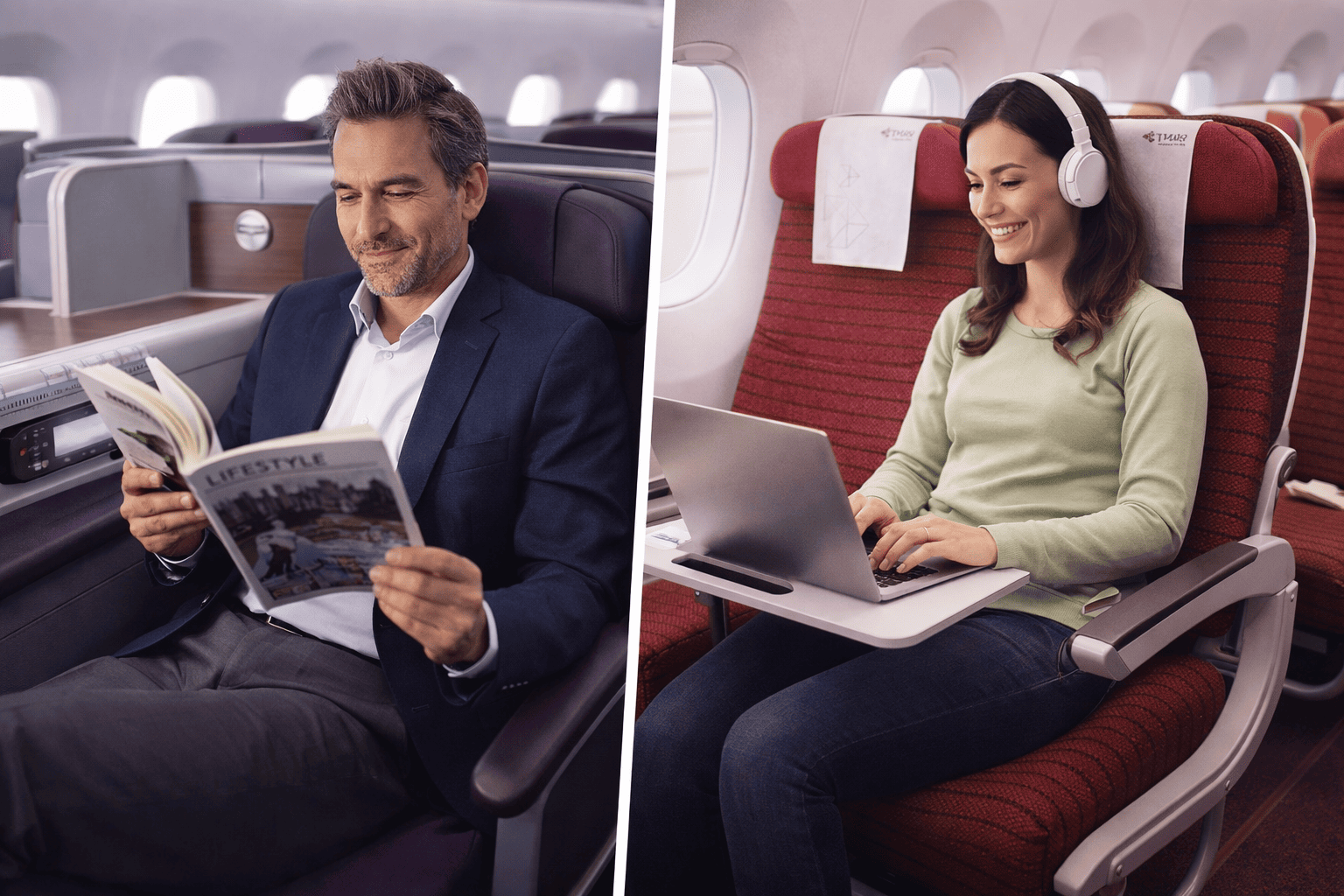



Smart travelers today prioritize comfort where it truly counts and save where it doesn’t. Airlines consistently see stronger premium demand on long-haul and overnight flights, where sleep and arrival conditions matter most. Frequent flyer communities reflect the same pattern: miles are often redeemed for long-haul business class, while shorter domestic segments are paid in cash.
Our own AranGrant customer insights support this behavior. In recent surveys, US-based clients told us they prefer premium economy on domestic routes and reserve business class for long-haul journeys.
The takeaway is simple: in modern premium travel, thoughtful strategy often matters more than blanket luxury. In this guide, we’ll answer the question: what is a mixed cabin flight? We’ll also explore when it makes sense to mix cabins and when going fully business class is the smarter, more rewarding choice.
Read in this post:
Next in the series: Best Premium Economy Airlines in 2026
What Is a Mixed Cabin?
A mixed cabin flight is a single ticket where different segments are booked in different classes of service. Instead of flying the entire itinerary in one cabin (such as business or economy), one leg may be in business class while another is in premium economy or economy. All segments remain part of the same booking, but the cabin changes along the way.
This usually happens because fare availability and pricing are managed separately for each segment. For example:
Dallas (DFW) → New York (JFK)
- Flight time: ~3h 30m
- Economy one way: typically $170–$300
- Business one way: often $500–$600
New York (JFK) → Madrid (MAD)
- Flight time: ~7h 10m overnight
- Business class one way: typically $2,400–$3,000
On the same ticket, the shorter domestic segment may be booked in economy, while the overnight transatlantic flight is booked in business.
Another example:
Los Angeles (LAX) → Tokyo (HND)
- Flight time: ~11h 30m
- Business class one way: typically $2,700–$3,000
- Premium economy one way: $1,100–$1,500
Tokyo (HND) → Los Angeles (LAX)
- Flight time: ~10h 15m
- Business class one way: typically $3,300–$4,500
- Premium economy one-way: roughly $2,000–2,700
- Economy one-way: roughly $1,100–$2,200
In this case, one direction may be booked in business class, while the return is in premium economy. The ticket remains one itinerary, but the cabin simply varies by segment.
Next in the series: How to Upgrade to Business Class
Why Airlines Offer Mixed Cabin Tickets
Airlines allow this because fare inventory is managed leg by leg. As the numbers above show, pricing can differ meaningfully by direction. If business class is available or more attractively priced on one flight but not the other, the booking system combines what is open into a single ticket.
Therefore, mixed cabin tickets are not a special promotion or hidden fare type. They are a direct result of how airlines manage inventory and price seats. Every flight is divided into fare buckets: separate inventory categories within each cabin.
A business class cabin, for example, may have multiple booking classes at different price levels. The same is true for premium economy and economy. These fare buckets are controlled leg by leg, not for the entire round trip. That means:
- Business class may be available at a competitive price on one segment
- The same cabin may be sold out or priced higher on the return
- Premium economy may still have lower fare buckets open in one direction
- Economy may have wider availability across shorter domestic legs
Airlines use dynamic pricing systems that adjust fares based on demand, seasonality, booking pace, and remaining inventory. Directional demand often differs, especially on long-haul routes. An overnight eastbound flight may sell business seats quickly, while the daytime return may not. Or vice versa.
When the booking engine searches availability, it combines whatever fare buckets are open for each segment. If business class is reasonably priced on one leg but significantly higher on the other, the system will naturally build a mixed itinerary.
In other words, mixed cabin tickets exist because:
- Inventory is managed per flight segment
- Pricing fluctuates by direction
- Demand is not symmetrical
Airlines are not intentionally encouraging cabin mixing. They are simply selling what is available at the time of booking. A mixed cabin itinerary is therefore a reflection of real-time availability and pricing logic.
What This Means for You: When reviewing flight options, look at each segment individually, not just the total fare. Cabin availability and pricing often differ by direction, and that difference can work in your favor. Instead of filtering only for “business round-trip,” explore combinations. You may find that premium comfort is available where it matters most, without paying for it where it doesn’t. A thoughtful review of segment-level pricing can turn airline inventory logic into a smarter travel decision.

Next in the series: Best Business Class Seats in 2026
When Mixing Cabins Makes Strategic Sense
Mixing cabins isn’t a downgrade, it’s allocation. You’re placing comfort where it delivers the greatest return. Below are situations where combining business, premium economy, or economy is not only logical but financially intelligent.
Overnight Long-Haul in Business, Daytime Return in Premium Economy
If sleep is the priority, protect it.
New York (JFK) → London (LHR)
- Flight time: ~6h 45m (overnight)
- Business one way: ~$2,200–$2,800
- Premium economy one way: ~$600–$1,100
London → New York
- Flight time: ~7h 45m (daytime)
- Premium economy one way: ~$960–$1,100
- Economy one way: ~$400–$500
Eastbound transatlantic flights are short and depart late. A lie-flat seat meaningfully changes how you arrive. The daytime return is easier to manage in a well-designed premium economy cabin.
This logic also applies to:
Boston → Paris (~7h 10m)
Washington, D.C. → Rome (~8h 30m)
Long Us Domestic (5–6 Hours): Business Isn’t Always Proportional
As of early 2026, most US domestic first/business cabins still offer recliner seating, not full lie-flat, except on select premium transcontinental routes.
New York → Los Angeles
- Flight time: ~5h 45m
- Standard business one way: ~$1000–$1,200
- Economy one way: ~$140–$220
Miami → Seattle
- Flight time: ~6h 20m
- Standard business one way: ~$640–$1,200
- Economy one way: ~$200–$400
Unless you are on a true premium transcon aircraft, the comfort difference may not justify the price gap. In many cases, exit-row or premium economy-style seating delivers most of the comfort for significantly less.
Business Outbound for a Milestone, Economy Home
Sometimes it’s about how you arrive, not how you return.
Chicago → Honolulu
- Flight time: ~9h
- Business one way: ~$900–$1,200 (with a one-stop connection and lounge privileges)
- Economy one way: ~$530 (non-stop)
Arriving rested for a wedding, conference, or cruise departure can justify business class. The return flight may not require the same investment.
Premium Economy When It’s Genuinely Strong
On certain carriers, premium economy narrows the gap with business class. Airlines such as Virgin Atlantic, Air France, and Japan Airlines offer 38” seat pitch, wider seats, smaller and quieter cabins, and enhanced dining. Consider:
San Francisco → Tokyo
- Flight time: ~10h 45m
- Business one way: ~$2,700–$4,000
- Premium economy one way: ~$1,500
If business spikes but premium economy remains stable, protecting one leg in business and the other in premium economy often reduces total spend by several thousand dollars.
Mixing Airlines Strategically
Not all segments deserve premium pricing.
Chicago → Madrid (Iberia, business)
- Flight time: ~9h 30m
- Business one way: ~$4,000
Madrid → Rome
- Flight time: ~2h 30m
- Economy one way: ~$30–$200
Paying business class for a short intra-Europe flight with a blocked middle seat rarely adds meaningful value.
Similarly:
- Long-haul on Emirates (true international business)
- Domestic US connection on United in economy
You preserve the premium experience where it matters most.
Domestic Red-Eye in Lie-Flat, Short Hop in Economy
A subtle but effective move.
Los Angeles → New York (JFK premium transcon)
- Flight time: ~5h 30m (overnight)
- American Airlines lie-flat business one way: ~$1,300
New York → Boston
- Flight time: ~1h 10m
- Economy one way: ~$140–$300
Protect sleep on the overnight leg. Avoid overpaying for a short morning connection.
When Business Pricing Becomes Irrational
Sometimes directional pricing creates imbalance. Example pattern:
Miami → Buenos Aires
- Flight time: ~9h
- Business one way: ~$2,200
- Premium economy one way: ~$1,000
Return business may price significantly higher, pushing a full round-trip to ~$3,800–$4,500. Booking business one way and premium economy the other can reduce total cost while preserving comfort on the longer or overnight leg.
This pattern also appears on routes like:
Los Angeles → Sydney (~14h 30m)
When price gaps widen, mixing cabins becomes a rational adjustment, not a compromise.
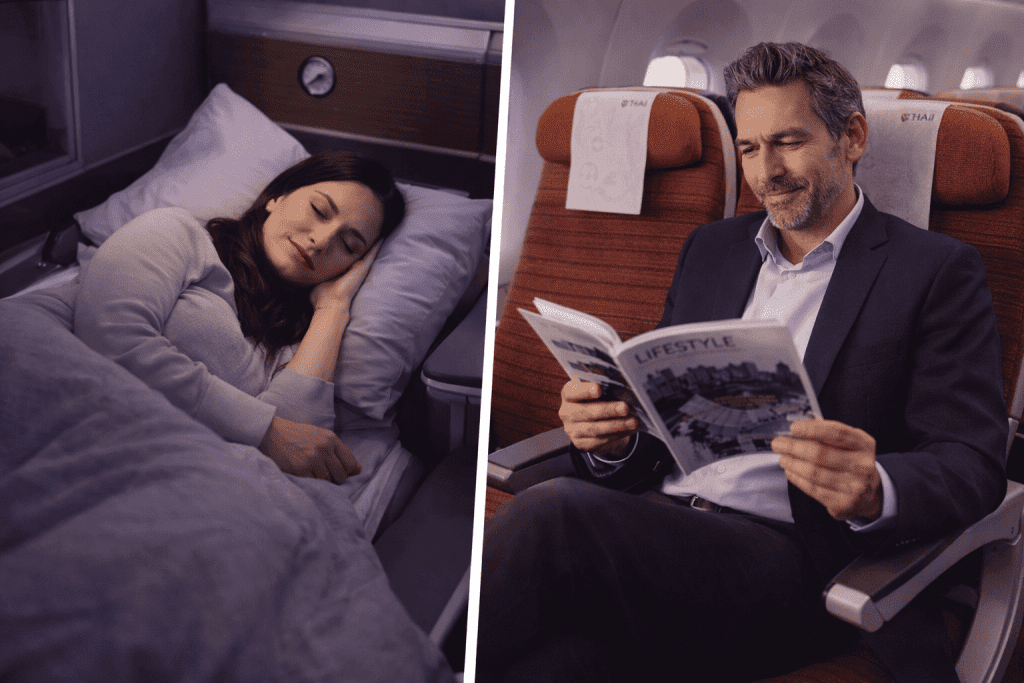
The Principle: Mix cabins when one direction carries higher sleep value, a short segment doesn’t justify premium pricing, fare differences are directional, or when a premium economy product meaningfully narrows the gap. The goal is not uniform luxury. It’s calibrated comfort. When you align cabin choice with flight length, timing, and pricing logic, the result often feels both more rational and more refined.
Next in the series: When Business Class Costs Almost the Same as Economy (And Why)
When Mixing Cabins Does Not Make Sense
Cabin mixing works best when comfort needs vary by segment. But in some situations, consistency matters more than savings. Here’s when booking the same cabin both ways is a wiser choice.
If Lounge Access Both Directions Matters
Business class typically includes lounge access. Premium economy and economy usually do not, unless you hold elite status or a premium credit card. Imagine a long connection:
Chicago → Doha → Bangkok
- Chicago → Doha: ~13h
- Doha → Bangkok: ~6h
- Layover: 4–6 hours
In business class, that stop may include lounge dining, shower facilities, and quiet rest areas. In premium economy or economy, the same connection may mean several hours in the general terminal. For travelers who value workspace, dining, or simply a calm place to reset, losing lounge access on one leg can meaningfully change the experience.
Did You Know?: On itineraries with long connections, lounge access is granted where your business-class segment departs, not automatically at every stop. For example, imagine you fly Chicago → Doha in business class, followed by Doha → Bangkok in premium economy. You would typically receive lounge access in Chicago before departure. However, during your connection in Doha, lounge access may not be included, since your onward segment is not in business class. Because policies vary by airline, fare class, and alliance rules, it’s wise to confirm the details in advance. If you book with AranGrant, our team can review lounge eligibility for each segment before you travel.
If Baggage Rules Differ by Segment
Baggage allowances are tied to cabin and fare class. When cabins differ, so can the rules, especially if separate fare families apply. For example:
Chicago → Honolulu
- Business one way: typically 2 checked bags included
- Economy basic return: may include no checked bag
While baggage fees alone rarely exceed the price difference between cabins, they can reduce the savings of mixing and introduce unnecessary complexity, creating avoidable friction at check-in. For travelers who value simplicity and predictability, uniform baggage allowances across both directions can be more important than the incremental savings from mixing cabins.
If Elite Benefits Depend on Fare Class
Frequent flyer benefits like upgrades, priority boarding, or mileage earning can vary by booking class. On many programs:
- Business class earns higher mileage multipliers
- Discounted premium economy earns less
- Basic economy may restrict upgrade eligibility
If maintaining or qualifying for elite status is part of your travel strategy, mixing cabins could reduce mileage accrual or upgrade priority on one leg. In that case, the short-term savings may conflict with long-term loyalty goals.
If the Return Flight Also Requires Real Sleep
Not all return flights are easy daytime segments. Consider:
- Los Angeles → Sydney: ~14h 30m overnight
- Sydney → Los Angeles: ~13h 45m, often departing late evening
If both directions are overnight or ultra-long-haul, protecting sleep only one way may not be enough. On routes exceeding 12–14 hours, recovery time matters in both directions. If rest is critical both ways, consistency may outweigh cost savings.

Next in the series: Best Business Class Lounges: Global Leaders for 2026
Mixed Cabin vs Round-Trip Business Class
A mixed cabin itinerary combines different classes of service across segments. Take for example business class on the overnight long-haul and premium economy or economy on the return. A round-trip business class ticket keeps the cabin consistent in both directions.
The difference is not just comfort, but structure. Round-trip business offers uniform service, consistent baggage allowance, lounge access both ways, and full mileage accrual at the business rate. A mixed cabin ticket adjusts comfort by segment and may change lounge eligibility, baggage rules, and earning rates on certain legs.
Round-trip business prioritizes simplicity and consistency. A mixed cabin prioritizes allocation, placing premium comfort where it delivers the most value. Neither approach is inherently better. The smarter choice depends on whether you value uniform luxury or calibrated efficiency.




![arangrant flight booking statistics 2026 Pay Less for Business Class in 2026 [Without Chasing Myths]](https://arangrant.com/wp-content/uploads/sites/3/2025/12/arangrant-flight-booking-statistics-2026.png "Pay Less for Business Class in 2026 [Without Chasing Myths] 7")


