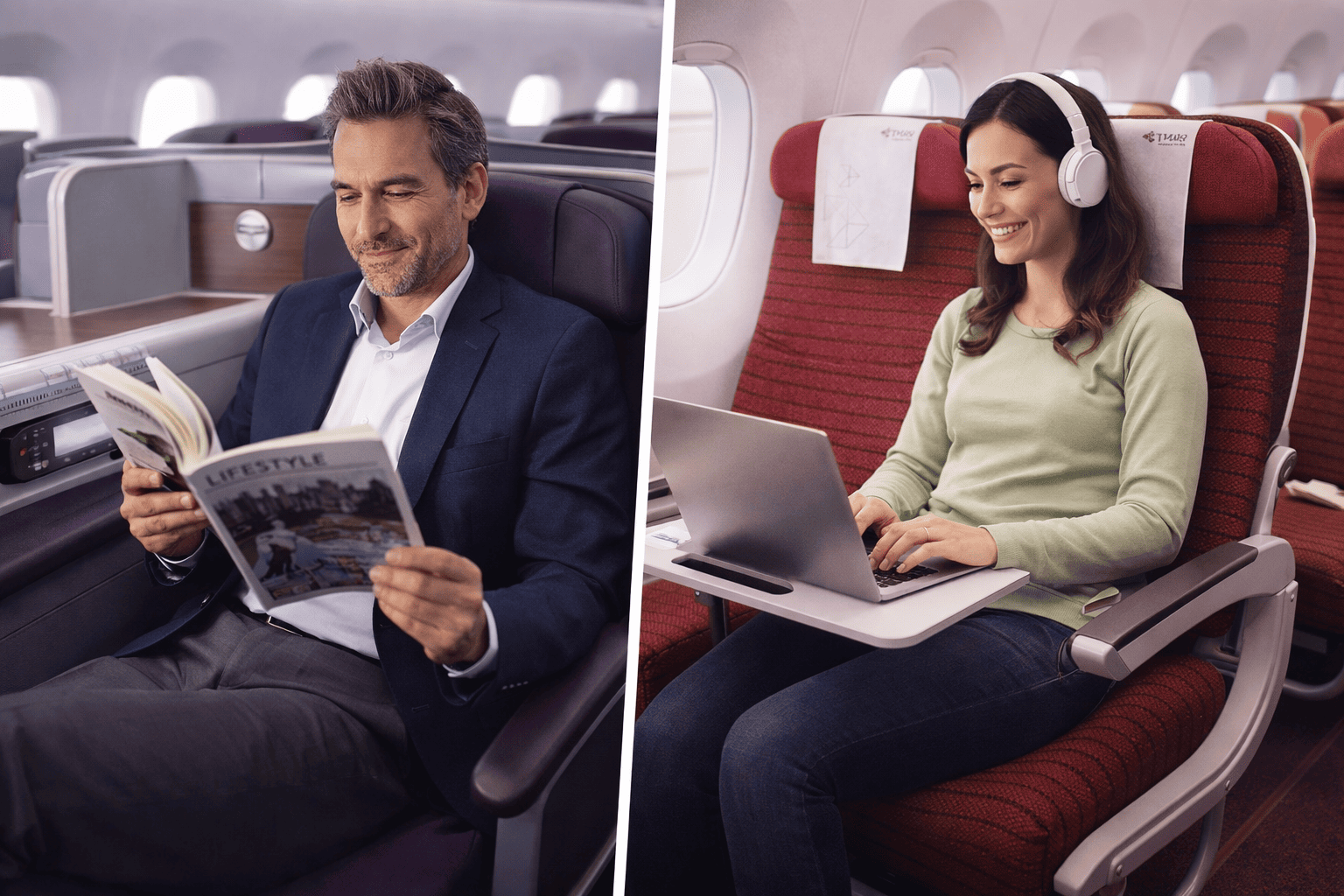



March sits in a rare in-between window. The holiday surge has faded, yet summer pricing has not fully taken hold. On many long-haul routes, inventory remains flexible and seat maps are still generous.
For premium travelers, this often translates into better seat selection, a higher likelihood of operational upgrades, and quieter flagship lounges. The effect is most visible for the US to Western Europe, US to Japan before late-March cherry blossom demand peaks, and US to the Middle East.
In short, March is when thoughtful premium travelers secure comfort before summer pressure begins to reshape availability.
That is why we are launching our monthly Premium Flight Digest in March. Each edition will offer a concise, well-curated update on the most important developments affecting premium travel in 2026: route adjustments, new cabin launches, pricing shifts, lounge updates, and other meaningful changes.
Visit our blog early next month for the next update. And for a broader perspective, explore our full 2026 premium airline outlook in the main industry trends guide.
Read in this post:
Executive Snapshot: Top 5 Signals of the Month
For time-poor premium travelers, here are the five signals shaping March:
- Demand: United reports double-digit premium revenue growth and record business sales weeks. Delta and American cite strengthening corporate channels. No softness language anywhere.
- Pricing: International premium average fares remain structurally elevated (around $1,400+ via agency data). No discount cycle forming.
- Geopolitics: Airspace restrictions tied to the Iran conflict are causing selective rerouting across Gulf corridors, extending block times on some Europe–Asia and US–Middle East itineraries.
- Product: A350 and 787 fleets now dominate flagship long-haul routes. Suite-style cabins (Qsuite, Delta One Suite, Polaris, Allegris rollout) are concentrated on high-yield corridors.
- Access: Lounge entry across major US hubs is more tightly controlled during peak departure banks, but paid premium passengers remain prioritized.
That’s the landscape.

Business Class Demand Shifts
US – Europe: Still Firm Heading Into Spring
All three US network carriers are signaling steady premium demand:
- Delta Air Lines expects March-quarter revenue growth and improving corporate demand.
- United Airlines reported double-digit premium revenue growth and record business sales weeks in January.
- American Airlines says early 2026 strength is being led by premium cabins and corporate channels.
There is no language about discounting or excess capacity. Core corridors such as New York–London, Boston–Paris, and Chicago–Frankfurt are likely to remain firm through late April.
US – Asia: Demand Intact, Watch Routing
United is expanding widebody capacity in 2026 and adding international routes. Emirates reports sustained premium demand across regions, including Asia flows, alongside capacity up 5%, passenger traffic up 4%, and continued premium expansion (A350 deliveries and retrofits).
There is no evidence of distressed pricing from Gulf carriers. The variable is operational. Middle East airspace disruptions are affecting routing reliability on some Asia-bound itineraries. Demand remains strong; routing stability is the swing factor.
Gulf Carrier Premium Loads: No Weakness Signal
Emirates again posted record profitability and directly attributed revenue growth to premium cabin preference. There is no indication of yield pressure on the US–India, Africa, or Southeast Asia flows via Dubai. Premium fares via Gulf hubs are unlikely to soften materially in the short term.
Premium Transcon (Domestic US)
United reported its strongest business sales week in company history in January. Delta and American both highlighted improving corporate demand. None of the major carriers suggested domestic premium softness. Midweek corporate corridors such as NYC–LAX, SFO–EWR, and BOS–SFO remain structurally supported.
Read also: Best Luxury Beach Destinations: Summer 2026
Booking Window and Demand Behavior
January agency air ticket sales reached approximately $10 billion, up 7% year over year. International trips rose 8%. Premium class average fares held steady month over month and remain elevated. Airlines are expanding premium cabin capacity into summer, but importantly:
- Premium revenue is growing faster than main cabin revenue.
- Seat growth in 2026 is skewed toward premium cabins, not economy expansion.
This is the structural insight. Airlines are adding premium seats without discounting them. That reflects forward demand already committed.
Corporate agency trips declined slightly year over year, while leisure-focused agency trips increased 6%. Premium demand is not dependent solely on last-minute executive travel. Planned leisure premium is contributing meaningfully and that segment books earlier and more deliberately.
Booking Strategy Implication
- Do not expect meaningful last-minute collapses in premium cabins.
- High-demand international routes will fill steadily rather than suddenly.
- Waiting into the final weeks before departure is more likely to reduce cabin choice than unlock value.
This is firmness with discipline, not overheating.
Premium Route Competition and Capacity Changes
March marks the start of the IATA summer schedule.
Portugal is strengthening its transatlantic positioning:
TAP Air Portugal (from March 29, 2026):
- New route: Porto – Terceira (Azores)
- Porto – Funchal frequency increase (14 to 18 weekly)
This improves one-stop connectivity from major US gateways and signals confidence in Atlantic leisure demand.
Additional competitive movements:
Delta Air Lines adds Porto–New York (JFK).
WestJet launches Lisbon–Halifax.
Secondary European gateways are quietly becoming more competitive than London or Paris.
Short-haul expansion by Ryanair and easyJet increases intra-Europe feed, indirectly supporting long-haul premium flows.
Cabin and Fleet Positioning in March
As summer schedules rotate in, high-probability suite corridors include:
- JFK–Doha (Qatar Airways Qsuite)
- LAX–Sydney (Delta A350 Delta One Suite)
- EWR–London (United Polaris 787)
- ORD–Frankfurt (Lufthansa A350 Allegris rollout)
Legacy 2-2-2 layouts are increasingly rare on these flagship routes. Fleet modernization continues to raise the baseline expectation for direct aisle access.

Lounge Access Evolution
There are no sweeping policy resets in March. What’s evolving is enforcement:
- Peak-hour entry controls
- Capacity-based waitlists
- 2–3 hour pre-departure limits
- Prioritized entry for same-day premium cabin passengers
Credit card access is more conditional during peak banks, but paid business class access remains stable.
Travel Disruptions and Airspace Impact
Airspace restrictions across parts of Iran and neighboring Gulf corridors have led to selective rerouting and longer block times on some Europe–Asia and US–Middle East itineraries. Major hubs are gradually restoring operations, but:
- Some routings remain extended
- Connection buffers may tighten
This is an operational consideration, not a demand collapse.
What This Means for Premium Travelers
This is where positioning matters:
- Book Now vs Wait: For fixed spring and early summer dates, booking early protects seat selection and product consistency. The environment does not favor late-cycle bargain hunting.
- Best Competition Corridors: Secondary European gateways (especially Portugal and select German hubs) offer more nuanced competitive dynamics than London or Paris.
- Where Pricing Pressure May Ease: Shoulder-season leisure routes with incremental capacity may show modest tactical adjustments before peak compression.
- Where Inventory Compression Is Accelerating: Suite-equipped aircraft on corporate-heavy corridors are filling deliberately. Upgrade space may tighten faster than in prior years.
- How Uncertainty Shifts Psychology: Geopolitical disruption increases preference for nonstop routes and operationally stable hubs. That behavioral shift supports pricing firmness even without dramatic demand acceleration.
March is not a story of spikes or weakness. It is a story of structural support, controlled capacity, and disciplined forward booking. We will continue tracking the shifts that matter. Stay with us for next month’s premium update and travel ahead of the curve.