
Choosing business class is no longer just about the airline. On long-haul routes, the aircraft itself plays a decisive role in how comfortable, quiet, and restorative the journey feels. Two modern wide-bodies dominate premium long-haul fleets today: the Airbus A350 and the Boeing 787 Dreamliner.
Both were designed with efficiency, passenger well-being, and long-range flying in mind. Yet their cabins feel noticeably different in business class, regardless of the airline operating them. Understanding those differences helps travelers make better choices when fares and schedules are otherwise similar.
This guide focuses on what is inherent to each aircraft, then shows how airlines build on those foundations.
Read in this post:
What the Airbus A350 and Boeing 787 Have In Common: Why Both Work Well for Business Class
From a business-class perspective, the A350 and 787 share several strengths that explain their popularity across premium fleets.
Both aircraft offer lower cabin altitude and higher humidity than older wide-bodies, which reduces dehydration and fatigue on long flights. Pressurization typically sits closer to 6,000 feet rather than the traditional 8,000, a difference many travelers feel on overnight routes.
They are also quieter than previous generations, thanks to modern engines, advanced insulation, and refined airflow. This matters more in business class than economy, where sleep quality is often the primary goal.
Finally, both aircraft support true long-haul range, allowing airlines to operate nonstop routes of 10–15 hours without compromise. That consistency is why these jets anchor flagship routes across Europe, Asia, and the Americas.
Where they differ is how that comfort is delivered inside the cabin.
Airbus A350 Business Class: Space, Calm, and Long-Haul Comfort
The Airbus A350 business class experience is defined by space and restraint. The aircraft’s wider fuselage gives airlines more flexibility when designing premium cabins, and passengers tend to feel it immediately.
Airbus A350 Business Class Seats
Most A350 business class cabins use a 1-2-1 layout. But the aircraft’s wider fuselage gives airlines more flexibility for seat width, console size, and aisle spacing. Even without doors, seats often feel less boxed-in than on narrower aircraft such as the Boeing 787, Boeing 767, or long-range single-aisle jets like the Airbus A321LR and A321XLR. Older Airbus A330 business class cabins can feel similarly constrained, largely due to earlier seat designs rather than fuselage width itself.
This geometry benefits both window and center seats, especially for travelers who value shoulder room and personal space over visual drama.
Width, Privacy, and Sleep Comfort
A350 cabins are often described as calmer rather than more luxurious. Noise levels are low, vibrations are minimal, and airflow feels even throughout the cabin. These qualities become more noticeable after several hours in the air.
For sleeping, the combination of width and stability matters. The A350’s smooth ride and quieter baseline make it easier to stay asleep once settled. That’s a key advantage on overnight or ultra-long-haul flights.
Airline Examples That Execute the A350 Well
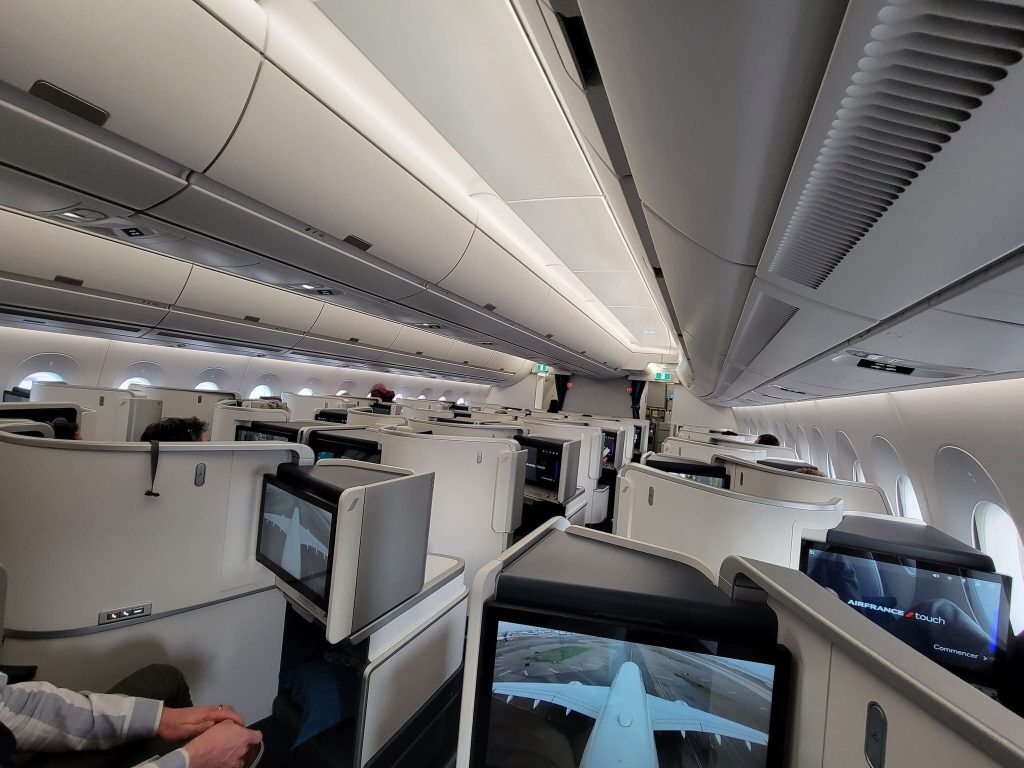
Airlines such as Qatar Airways, Singapore Airlines, Air France, and Delta Air Lines show what the A350 can do at its best. Their business class cabins emphasize different priorities, including openness, visual calm, and suite-style privacy.
These cabins also share a consistent foundation of low noise, stable ride quality, and generous personal space. Even when seat designs vary significantly, the underlying comfort profile of the A350 remains recognizable.

Boeing 787 Business Class: Efficiency, Technology, and Availability
The Boeing 787 business class experience reflects a different design philosophy from the A350. The aircraft is narrower, lighter, and far more widely deployed across global long-haul networks. Those structural realities shape how business class seats are designed, packaged, and experienced.
Seat Layout and Cabin Density
Most 787 business class cabins use a 1-2-1 layout, but the aircraft’s narrower cross-section requires tighter packaging. Seat shells are often slimmer, consoles more compact, and footwells more angular, especially on aircraft configured for higher seat counts.
This doesn’t automatically translate to discomfort, but it does mean less tolerance for inefficient design. On the 787, small decisions such as seat pitch, console depth, and screen placement have a noticeable impact.
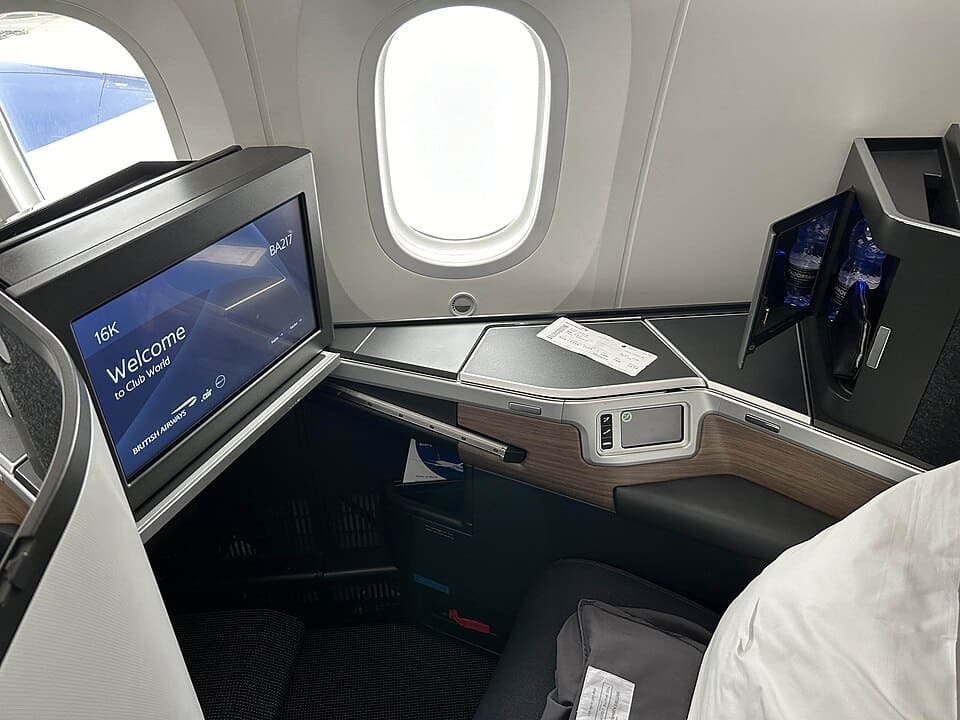
- Airlines that push density too far often sacrifice foot space and storage first. This is most noticeable on certain Boeing 787 business class configurations, including earlier Polaris layouts on United Airlines, Club Suite on British Airways’ 787s, American Airlines’ 787-8 and 787-9 cabins, and Air Canada’s Signature Class on the 787.
- Well-executed cabins, by contrast, feel far more deliberate. Clear sightlines, careful seat staggering, and restrained monument design can preserve a sense of order even within the aircraft’s physical limits. Japan Airlines (JAL) prioritizes generous footwells and straight sleeping surfaces, accepting lower seat density in return. Storage is limited but thoughtfully placed, keeping the cabin comfortable overnight. All Nippon Airways (ANA) similarly emphasizes ergonomic alignment over enclosure on its 787s, improving leg comfort despite the narrower fuselage.
Boeing 787 Business Class Seat: Structure, Ergonomics, and Sleeping Position
The 787 places greater emphasis on seat engineering than raw space. Because width is limited, comfort depends on how effectively the seat supports the body in both upright and sleeping positions.
Strong 787 business class seats tend to share a few traits:
- Firm but supportive cushioning that holds shape overnight
- Straight, well-aligned sleeping surfaces with minimal taper
- Footwells designed to accommodate side sleepers without forcing knee rotation
Where this is done well, sleep quality can rival that of wider aircraft. Where it isn’t, passengers feel boxed in quickly, particularly on longer sectors. The contrast is clear in the examples discussed in the Seat Layout and Cabin Density section above.
Unlike the A350, where width can mask mediocre seat design, the 787 exposes it.
Cabin Environment and Rest
The 787’s large windows and advanced air systems create a bright, modern atmosphere, especially on daytime flights. Lower cabin altitude and improved humidity help reduce fatigue, even when seat dimensions are tighter. Noise levels are still low compared to older wide-bodies, though engine sound can be slightly more noticeable near the wings than on the A350.
For overnight flights, rest quality is more seat-dependent than airframe-dependent. A thoughtfully designed 787 business class can deliver excellent sleep.
Airline Examples Elevating the 787
Airlines such as JAL and ANA demonstrate how refined a 787 business class can feel when density is controlled and ergonomics are prioritized. Their seats emphasize alignment, usable foot space, and predictable comfort.
United Airlines shows the other side of the spectrum. On newer 787 interiors with updated seats and finishes, the experience is solid and consistent. On older or higher-density configurations, space compromises are more noticeable.
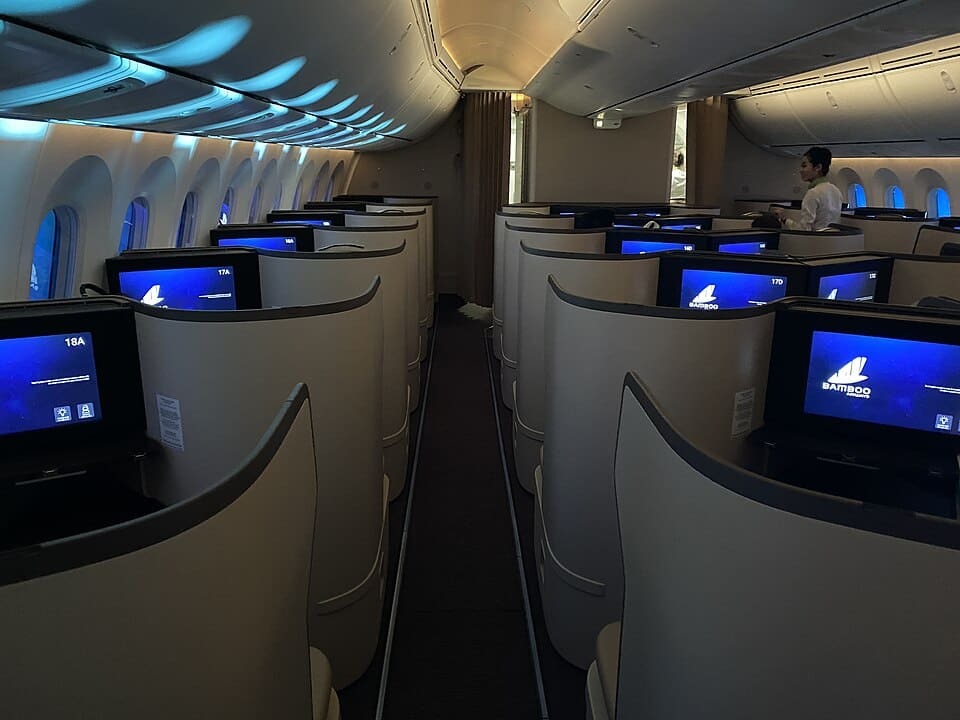
Other carriers, including Bamboo Airways, offer a more conventional implementation. It’s comfortable and fully lie-flat, but with limited storage and less margin for side sleepers on longer sectors.
Because the 787 is so widely used, business class quality varies more by airline and configuration than on the A350. The aircraft rewards precision and exposes shortcuts.
When to Choose Each Aircraft and Which Airlines to Prioritize
Choosing between the A350 and the 787 is less about “better” and more about fit.
Choose the Airbus A350 if:
- You prioritize quiet cabins and stable sleep
- You’re flying overnight or ultra-long-haul
- You value seat width and personal space
- You’re sensitive to noise or vibration
Best paired with airlines that emphasize calm, premium consistency, such as Qatar Airways, Singapore Airlines, and Air France.
Choose the Boeing 787 if:
- Route availability and scheduling matter more
- You’re flying daytime or medium-long haul
- The airline operating the flight is known for strong seat design
- You prefer newer cabins on thinner long-haul routes
Best results come from carriers like JAL, ANA, and select United Airlines routes with updated interiors.
Read also: Why Business Class Costs So Much
Final Perspective
Both aircraft represent the modern baseline for business-class travel. The Airbus A350 tends to deliver a more forgiving, restful environment. The Boeing 787 offers flexibility and reach, with comfort shaped heavily by airline choices.
When fares are close, the aircraft type can meaningfully influence how you feel at arrival — sometimes more than the airline brand itself. Knowing which strengths matter most to you makes that choice far more intentional.
Frequently Asked Questions
Is business class on the Airbus A350 better than on the Boeing 787?
In most cases, yes (particularly for long-haul comfort). The Airbus A350’s wider fuselage allows for wider seats, larger consoles, and more forgiving aisle spacing. This often translates into a less boxed-in feel and better sleep quality, especially on overnight flights. That said, a well-designed Boeing 787 business class seat can still be very comfortable, depending on the airline.
Does Airbus A350 business class always include suites with doors?
No. Some airlines use enclosed suites, while others prefer open designs. For example, Delta Air Lines uses full Delta One Suites with doors on its A350s. Airlines like Singapore Airlines and Air France favor open layouts that emphasize visual space and calm. Both approaches benefit from the A350’s inherently quiet, stable cabin.
Is Airbus A350 business class better for long-haul flights than short ones?
The advantages of the A350 are most noticeable on long-haul and ultra-long-haul routes. On flights over eight hours, reduced noise, cabin stability, and space become increasingly important. On shorter sectors, differences between aircraft types are less pronounced.