The 2026 FIFA World Cup will arrive in the United States this summer, bringing together 48 nations and decades of history. Much of the conversation will focus on rivalries and television audiences. The tournament itself, though, tells only part of the story.
Long before football became global entertainment, certain cities turned the game into something far more personal. In those places, football became a way for communities to express identity, memory, pride, and belonging. The sport still explains parts of a city that architecture, museums, and guidebooks cannot fully capture on their own.
For travelers who prefer to understand a destination rather than simply pass through it, these are some of the cities where football still carries its deepest meaning.
Read in this post:
Buenos Aires: where football became a philosophy

In Buenos Aires, football is woven into daily life in ways that visitors notice almost immediately. Conversations about clubs, matches, and players move through cafés, taxis, family dinners, and neighborhood bars with the same regularity as politics or economics.
What makes the city distinct is that football culture changes from one barrio to another. Each neighborhood developed its own relationship with the game, shaped by immigration, class, geography, and local identity.
The neighborhood that shaped the city
La Boca remains the clearest expression of Buenos Aires’ working-class football identity. Genoese immigrants founded Boca Juniors there in 1905, near the old port district. The neighborhood later became home to one of the world’s most recognized football clubs, while River Plate, another of Argentina’s defining teams, also originated in La Boca before relocating north.
La Bombonera remains one of the most recognizable football stadiums, known for its “Chocolate Box” design, steep stands, and unusually intense atmosphere. The stadium officially holds approximately 54,000–57,000 spectators.
Where to stay and how to experience Buenos Aires
The neighborhood you choose shapes the rhythm of the trip more than most first-time visitors expect.
- Palermo Soho
This neighborhood is best for bookstores, cafés, galleries, and late-night restaurants. It reflects a more cosmopolitan and intellectual side of Buenos Aires, where football often becomes discussion and analysis as much as spectacle. As of spring 2026, well-located boutique hotels in Palermo Soho generally range from about $250–$450 per night. - Recoleta
Recoleta is quieter and more architectural, known for its Paris-style townhouses, former palaces, museums, luxury boutiques, and historic hotels. In 2026, high-end hotels in the area usually start at about $350 per night, while landmark luxury properties often exceed $600. - La Boca
This neighborhood is essential to visit, especially around La Bombonera and Caminito, but less practical as a place to stay. The neighborhood works best as part of a daytime visit focused on football history and the city’s immigrant roots.
Food also forms part of the city’s football culture. Near La Bombonera, the historic bodegón and parrilla El Obrero still attracts locals before and after matches. Its walls are covered with club memorabilia, signed photographs, and old portraits of players and supporters. The restaurant specializes in traditional Argentine grilled meats and preserves the classic porteño atmosphere that still defines much of La Boca.
Naples: where football became religion
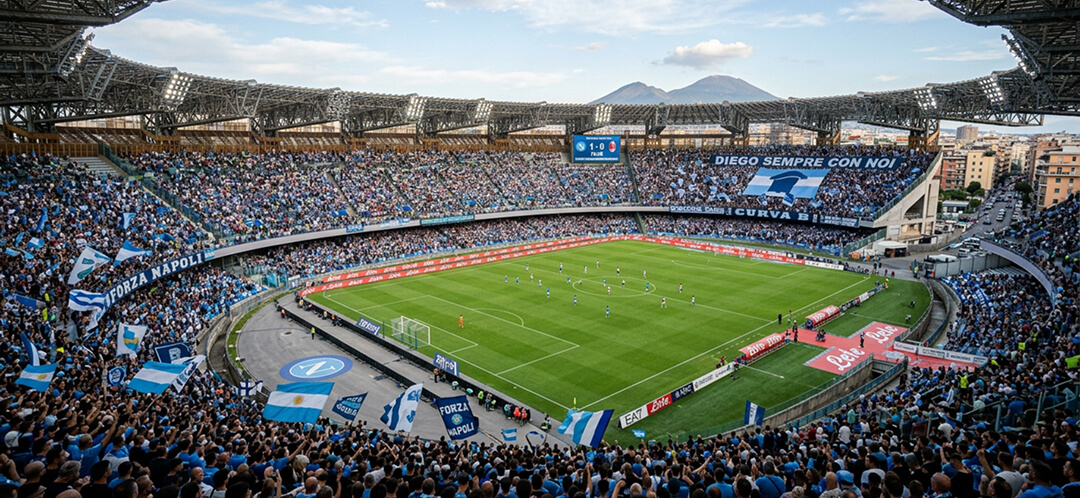
Many affluent American travelers pass through Naples rather than truly spending time there. Some continue directly toward the Amalfi Coast, while others treat the city mainly as a gateway to Pompeii or southern Italy.
That hesitation often comes from the same perception: Naples feels chaotic at first encounter. The streets are louder and less polished than many other Italian destinations. Yet that intensity also explains why the city leaves such a strong impression on the people who engage with it properly.
In Naples, football became part of the city’s identity because the sport reflected the same emotions the city already carried: pride, defiance, loyalty, and a refusal to be overlooked.
The city Maradona changed
Widely regarded as one of the greatest footballers in history, Diego Maradona became far more than an athlete in Naples.
When Diego Maradona arrived at Napoli in 1984, the transfer changed more than the club’s fortunes. Southern Italy had long existed in the shadow of the country’s wealthier north, both economically and culturally. Maradona gave Naples a global symbol entirely its own. During his seven seasons with Napoli, the club won its first two Serie A titles, in 1987 and 1990, along with the 1989 UEFA Cup, still the club’s only major European trophy.
In the Quartieri Spagnoli neighborhood, murals of Maradona cover entire building facades. Small shrines appear beside market stalls, inside cafés, and above barbershop mirrors.
Where to stay and how to experience Naples
- Quartieri Spagnoli
Dense and energetic, Quartieri Spagnoli sits in the heart of Naples. Originally built in the 16th century to house Spanish soldiers, the neighborhood still retains much of its historic character today. In 2026, boutique hotels and restored apartments in the area generally range from $180 to $600 per night. - Chiaia
This is an elegant, seaside district known for its high-end fashion boutiques, scenic seafront promenades, waterfront cafés, and stylish restaurants. High-end hotels in Chiaia usually cost about $350–$700 per night in 2026.
Food also represents Naples as clearly as football does. Near the historic center, L’Antica Pizzeria da Michele has operated since 1870 with remarkable simplicity. The restaurant still operates on a cash-only basis, the menu famously centers on just two pizzas, Margherita and Marinara, and long queues regularly form outside.
Dakar: where football became identity

Dakar rarely appears on the shortlist of premium cultural destinations for American travelers. Yet the city offers one of the most layered urban experiences in West Africa.
That becomes easier to understand once you see how football functions in Senegal. The game feels communal before it feels commercial, shaped less by clubs and stadiums than by neighborhoods and daily life.
Senegal’s national team, known as the Lions of Teranga, has become one of Africa’s most respected football programs, winning the Africa Cup of Nations in 2022 and consistently performing strongly on the international stage.
Football and the spirit of Teranga
In Dakar, football spills naturally into daily life. Matches unfold on beaches, side streets, courtyards, and open lots across the city, often gathering spectators from the surrounding neighborhood.
The atmosphere surrounding the game reflects teranga, a Wolof concept describing generosity and hospitality toward strangers that remains central to Senegalese culture. That same openness shapes the experience of the city itself.
Where to stay and how to experience Dakar
- Dakar-Plateau
Dakar’s historic center is known for its galleries, restaurants, and colonial-era architecture. The area also places travelers close to the Musée des Civilizations Noires, opened in 2018 and widely considered one of Africa’s most architecturally significant museums. High-end hotels in Plateau generally range from $150–$700 per night in 2026. - Almadies
It is a quieter coastal district with oceanfront restaurants, cafés, and boutique hotels. Premium hotels and serviced apartments in the area for summer 2026 usually range from roughly $250–$720 per night.
For a slower rhythm, Ngor Island offers one of Dakar’s most memorable day trips. A short pirogue ride from the mainland brings visitors to a quieter setting of small beaches, fishing boats, and open-air cafés that feels noticeably removed from the pace of the city.
Dakar also stands out for its culinary culture, shaped by Senegalese, French, and Lebanese influences.
How to visit these cities the right way

Cities such as Buenos Aires, Naples, and Dakar work best when you allow the trip to unfold at a slow pace. The experience depends less on checking landmarks off a list and more on spending time in neighborhoods, cafés, restaurants, and public spaces that gradually reveal the character of the city.
- Allocate more time than you think you need
Buenos Aires and Naples reveal themselves slowly. A two-night stay rarely gives visitors enough time to settle into the neighborhoods or experience the cities beyond their main landmarks. Three nights should feel like a great starting point, with one week offering the perfect amount of time to immerse yourself in the cities.
Dakar is also suitable for a slower pace, particularly for travelers interested in museums, music, food, and the city’s coastal atmosphere.
- Choose the flight as carefully as the destination
On long-haul routes, cabin choice affects far more than comfort alone. A 10-hour overnight flight to Buenos Aires in economy creates a very different arrival experience from the same route in a fully flat business-class seat. For travelers planning to spend long days walking through neighborhoods and lingering over late dinners, arriving rested is important.
- Pay attention to neighborhoods and logistics
These cities require more attention than generic booking platforms usually provide. Naples changes dramatically from one district to another. Dakar depends heavily on hotel selection and local logistics. Buenos Aires offers remarkable value, though the experience can feel completely different depending on the neighborhood.
The right combination of premium flights, conveniently located hotels, and pacing often determines whether a trip feels smooth or unnecessarily exhausting. At AranGrant, our travel experts can help you navigate those decisions with care and clarity.
Interesting facts
- The Maradona effect
When Diego Maradona led Napoli to its first-ever Serie A title in 1987, celebrations spread across Naples for three days and shut down entire neighborhoods. Nearly 40 years later, murals of him still cover building facades throughout Quartieri Spagnoli, making Naples one of the few cities where a single athlete permanently shaped the visual identity of an entire district.
- The meaning of Teranga
Teranga, the Wolof word for hospitality, is so central to Senegalese identity that it appears in the national football team’s official nickname: the Lions of Teranga. The concept has no direct English equivalent and describes a form of generosity toward guests and strangers that remains deeply embedded in daily life across Senegal.