
Business class prices vary widely depending on where you fly. Two long-haul routes departing from the same US airport can differ in price by thousands of dollars. The difference often comes from flight distance, airline competition, and demand patterns. That is why the cheapest business class flights are not always found by airline or season alone. The destination itself often plays the biggest role.
To understand where premium travelers tend to find better value, we analyzed aggregated AranGrant premium booking dataset from US departures. The analysis focuses on long-haul routes and compares how business class pricing behaves across different regions and travel periods.
Read in this post:
Our analysis shows a clear pattern
- Transatlantic routes to Europe frequently offer some of the most competitive long-haul business class fares from the US.
- In contrast, destinations across East Asia and Oceania typically command higher premiums.
- Distance matters heavily. The farther you fly from the US, the more aircraft time, fuel, and operational cost airlines must cover.
- That is why premium fares to Australia or New Zealand often sit far above transatlantic routes.
- Shorter flights to Mexico, the Caribbean, and parts of Central America tend to produce the lowest premium fares in the dataset.
- Regional demand patterns also influence prices. Months dominated by transatlantic travel to Europe often appear more affordable. Periods with heavier demand for ultra-long-haul routes to Asia tend to push average fares higher.
- The dataset even shows Europe appearing slightly more competitive than South Asia in some cases, highlighting how strong airline competition on transatlantic routes can influence pricing.
In the sections below, we break down:
- where travelers can typically find the cheapest business class flights from the US
- which destinations offer the best premium value
- how pricing trends shift throughout the year.

Next in this series: When Business Class Costs Almost the Same as Economy (And Why)
Cheapest business class flights from the US
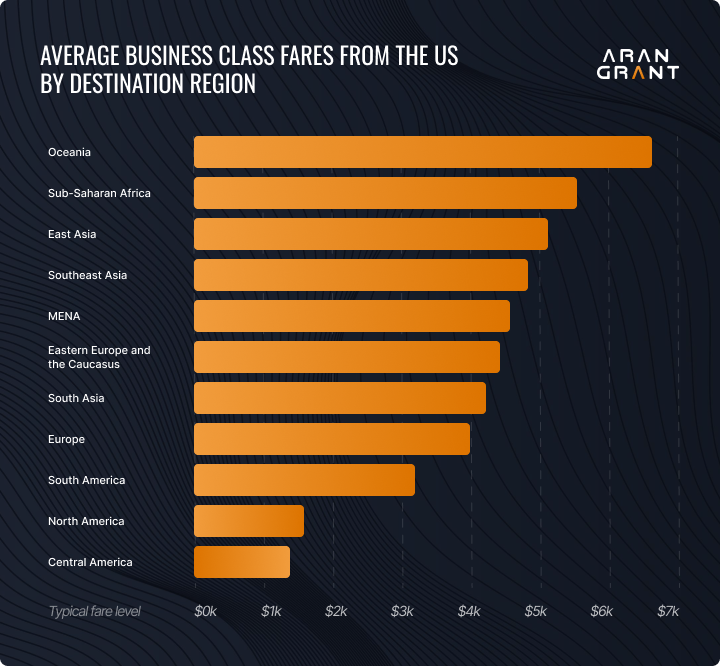
When premium booking data is grouped by destination region, three clear price tiers emerge.
Lower premium regions
The lowest business class fares typically appear on shorter international routes. Destinations in Central America, North America, and much of South America tend to offer the most affordable premium tickets. Such flights are relatively short and premium demand is lower than on major intercontinental routes. These markets also include many leisure-focused routes where airlines compete for price-sensitive travelers.
Mid-range long-haul regions
Long-haul routes begin to move into a higher pricing tier, but several regions remain comparatively competitive. Europe, India, Eastern Europe and the Caucasus, and parts of the Middle East fall into this middle range of premium pricing. Dense airline networks and strong transatlantic competition help keep fares within a narrower range than on many other intercontinental routes.
Higher premium regions
The highest business class fares usually appear on ultra-long-haul routes. Destinations across Southeast Asia, East Asia, Sub-Saharan Africa, and Oceania generally command higher prices. These flights involve longer travel times, higher operating costs, and fewer competing airlines on many routes.
Oceania remains the most expensive region overall in the dataset, reflecting the extreme distance from the US and the limited number of nonstop premium routes.
The image below illustrates typical business class fare ranges by destination region based on typical premium fare data.
Next in this series: Pay Less for Business Class in 2026 [Without Chasing Myths]
Cheapest business class flights to Europe
In AranGrant flight booking analysis, fares to major European cities frequently fall within the mid-$3,000 to mid-$4,000 range depending on the route and departure airport. One of the key drivers behind these prices is the intense competition on transatlantic routes. Flights between the US and Europe operate within one of the busiest aviation corridors in the world. Multiple airlines serve the same city pairs from major US hubs, increasing seat availability and helping keep premium fares within a relatively balanced range.
Major carriers operating heavily on these routes include Delta Air Lines, United Airlines, American Airlines, Air France, Lufthansa, and Iberia. With many airlines competing across the same routes, pricing pressure remains high and fares are frequently adjusted to stay competitive.
Flight distance also contributes to this pattern. Compared with routes to Asia-Pacific destinations, flights to Europe are shorter and require fewer operating hours. This allows airlines to maintain competitive pricing while still offering premium cabin service.
Cheapest business class to London
London remains one of the most heavily served transatlantic destinations from the US. Despite consistently strong demand, business class fares to London often stay within the typical European range because multiple airlines operate nonstop flights between major US hubs and the British capital. This high level of airline competition helps keep premium pricing relatively balanced compared with many other long-haul routes.
Cheapest business class to Paris
Paris follows a similar pattern. Frequent flights and strong competition across transatlantic routes help maintain relatively stable business class pricing. Premium fares to the French capital generally remain within the broader European range. This makes Paris one of the more consistent value destinations for long-haul business class travel.
The table below highlights typical business class fare ranges to major European cities.
| City | Market price ranges |
| Reykjavik | $2,200–$2,600 |
| Milan | $3,200-$4,000 |
| Venice | $3,400–$4,100 |
| Rome | $3,500-$4,200 |
| Amsterdam | $3,600-$4,400 |
| Paris | $3,600-$4,400 |
| Lisbon | $3,700-$4,500 |
| Madrid | $3,700-$4,500 |
| Barcelona | $3,700-$4,500 |
| Athens | $3,900-$4,700 |
| Zurich | $3,900-$4,800 |
| London | $3,900-$4,800 |
While Europe offers competitive pricing overall, some destinations stand out for particularly accessible premium fares.
Best-value business class destinations in Europe
- Reykjavik stands out as the lowest-priced destination in the dataset. Premium fares can begin around $2,200, reflecting the shorter transatlantic distance and route structure serving Iceland.
- Milan, Venice, and Rome often show lower business class fares compared with many other European hubs, making them attractive options for travelers seeking premium value.
- Amsterdam, Paris, Lisbon, Madrid, and Barcelona tend to sit in the middle of the regional price range.
- London and Zurich appear toward the upper end of the European spectrum. Both cities attract strong premium demand and serve as major financial centers. These factors can keep business class fares slightly higher than other destinations in the region.
Reykjavik appears as the most affordable premium destination in the dataset, with fares starting around a thousand of dollars below other European routes.
Next in this series: How to Find Cheap Business Class Tickets to Europe
Cheapest business class flights to Tokyo and East Asia
Business class travel to East Asia generally sits in a higher price range than transatlantic routes. In the analyzed booking trends, fares to major cities across the region frequently exceed those seen on many flights to Europe. The main reason is distance. Flights across the Pacific require longer operating time, which increases airline costs.
Airline competition also tends to be more limited on some transpacific corridors. While several carriers operate flights across the Pacific, the number of overlapping routes is smaller than on transatlantic networks. With fewer airlines competing on the same city pairs, pricing pressure is lower and premium fares remain higher overall.
Among the destinations in the dataset:
- Shanghai appears at the lower end of the East Asian range, with business class fares typically starting around $4,300 and reaching roughly $5,200 depending on route and departure airport.
- Tokyo follows with fares generally falling between about $4,700 and $5,700.
- Hong Kong sits toward the upper end of the regional spectrum. Premium tickets frequently range from roughly $4,900 to $6,000 (reflecting strong demand and the long distance from most US gateways).
Overall, East Asia remains one of the more expensive long-haul regions for business class travel from the US, especially when compared with transatlantic routes.
Next in the series: Unlock Exceptional Luxury at Unbeatable Prices: Special Price Business Class Flights
Cheapest business class flights to India
India appears more competitively priced than many travelers expect for an ultra-long-haul destination. In our booking data, several Indian cities fall within a price range that often sits below many routes to East Asia and other distant regions.
- Business class fares to Mumbai and Delhi frequently start around $3,500 and typically reach the low-$4,000 range depending on the departure airport.
- Hyderabad and Bangalore sit between the upper-$3,000s and around $5,000.
- Chennai tends to appear toward the upper end of the group.
Several factors help keep premium fares to India relatively competitive despite the long distance from the US. One driver is the large diaspora travel market connecting North America and India. Consistent demand encourages airlines to maintain regular service and competitive pricing.
Routing options also play a role. Many travelers reach India through one-stop connections via European or Middle Eastern hubs. This increases route availability and introduces additional airline competition. These connection options help moderate fares compared with routes that rely on fewer direct flights.
India stands out in the dataset as one of the more accessible long-haul regions for business class travelers departing from the US.
Next in the series: How to Find Cheap Business Class Tickets to India
Cheapest business class flights to Southeast Asia
Business class fares to Southeast Asia fall into the mid-range of long-haul premium pricing from the US. Most routes to the region cluster broadly between the upper $3,000s and the mid-$5,000s depending on the destination and departure airport.
- Among the major hubs in the dataset, Manila appears as the most competitively priced option. Business class fares often begin around $3,900 and typically remain below those seen on many other Southeast Asian routes. Strong diaspora travel and frequent connecting options help keep pricing relatively accessible.
- Ho Chi Minh City and Bangkok sit slightly higher in the regional range. Premium fares to these destinations generally start in the low-$4,000s and can reach the low-$5,000s depending on route availability and airline scheduling.
- Singapore appears toward the upper end of the Southeast Asia spectrum. Business class tickets frequently range from roughly $4,600 to $5,600, reflecting strong global demand and the city’s role as a major international aviation hub.
Southeast Asia sits between the lower-priced regions and the most expensive ultra-long-haul destinations, offering several cities where business class travel remains relatively attainable from the US.
Next in the series: Why Business Class Costs So Much
Cheapest business class flights to MENA
Cairo appears at the lower end of the regional range, with business class fares typically starting around $3,500 and reaching roughly $4,300. Istanbul and Dubai sit higher, with premium tickets often falling between about $4,000 and $4,900.
Several factors help keep pricing relatively balanced in this region. Many routes connect through major international hubs, which increases route availability and keeps fares relatively balanced. As a result, MENA routes often remain more competitively priced than ultra-long-haul destinations in Asia or Oceania.
Premium fares to the Middle East and North Africa generally fall in the middle tier of long-haul pricing from the US. Most routes to the region cluster between the mid-$3,000s and the upper-$4,000s depending on the destination.
Next in the series: What is the Difference Between Premium Economy and Business Class?
Cheapest Business Class Flights to Oceania
Typical fares to the region often fall between roughly $6,000 and $7,500. Sydney generally ranges from about $6,100 to $7,500. Auckland appears slightly higher, with business class tickets frequently reaching between $6,400 and $7,800.
For travelers searching for the cheapest business class flights to New Zealand, Auckland still represents the primary premium gateway. However, pricing remains elevated compared with most international destinations.
Oceania shows the highest premium fares in the dataset. The extreme travel distance from the US and limited airline competition keep business class prices significantly higher than on most other long-haul routes.
Next in the series: The Smartest Luxury Destinations for US Travelers (Close and Affordable)
Business class pricing trends by departure month
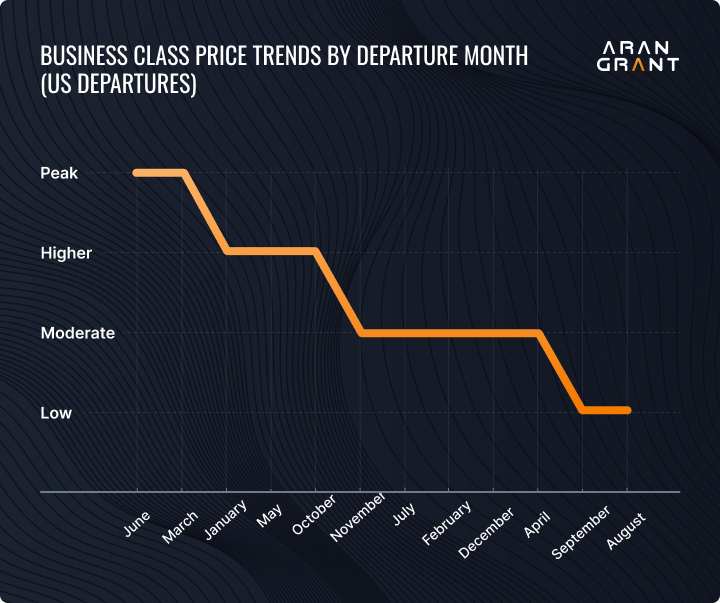
Business class fares change throughout the year, but the variation is moderate compared with many economy routes. According to our booking data, prices typically fluctuate within roughly a 10–12% range depending on the departure month.
Early summer shows the strongest pricing pressure. June stands out as the most expensive departure period in the dataset, reflecting strong travel demand and the start of the peak vacation season.
Better value often appears later in the year. Late summer and early fall tend to show more favorable pricing, with August and September consistently ranking among the lowest fare periods.
Next in the series: Average Business Class Ticket Price: Comparing Airlines, Trends, and Smart Picks
Best time to book business class flights
Business class fares tend to remain relatively stable across booking windows. Our analysis shows that price differences between early and late bookings are modest compared with the larger swings often seen in economy fares.
The earliest booking periods generally show slightly lower average prices. As departure approaches, fares tend to rise modestly, with the highest average levels appearing roughly three to four weeks before the flight. Last-minute bookings often remain close to that range.
| Booking window | Relative fare level in the dataset |
| 15–30 days | highest average fares |
| 0–14 days | slightly below the highest level |
| 31–60 days | similar to the late-booking range |
| 61–120 days | somewhat lower on average |
| 121+ days | lowest average fares |
Booking several months in advance tends to provide the most consistent value while also offering better seat availability in premium cabins.
Airlines that often offer competitive business class fares
Some airlines regularly appear in discounted business class deals on international routes. This observation reflects broader market patterns rather than specific AranGrant booking data.
European and connecting carriers often price premium cabins competitively, particularly on routes linking the US with Europe, the Middle East, and parts of Asia.
Airlines that frequently appear in business class promotions include TAP Air Portugal, Iberia, Turkish Airlines, Air France, and ITA Airways. These carriers often operate extensive international networks and compete strongly on connecting routes, which can help keep premium fares more accessible.
Next in the series: Fly Now Pay Later: How Affirm Makes Business and First Class More Accessible to AranGrant’s Customers
Why some business class flights are cheaper than others
Business class prices vary widely because several factors shape how airlines price premium seats.
- Flight distance is the most direct driver. Longer routes require more aircraft time, fuel, and crew, which increases fares. This is why ultra-long-haul destinations often appear at the top of the premium price range.
- Airline competition also plays a major role. Routes served by multiple carriers usually see more balanced pricing as airlines adjust fares to stay competitive.
- Route popularity influences demand patterns. High-demand destinations or financial hubs often maintain stronger premium pricing.
- Aircraft utilization matters as well. Airlines aim to maximize revenue on long-haul aircraft, especially on routes where premium cabins represent a large share of total ticket revenue.
- Corporate demand can push prices higher. Routes with consistent business travel tend to sustain stronger premium fares throughout the year.
Together, these factors explain why some routes consistently offer cheaper business class flights while others remain among the most expensive long-haul options.