Most people discover Turkish Cappadocia the same way: a photograph of hot air balloons drifting above a surreal volcanic landscape at dawn. That image is compelling enough to get you on a plane, but it is not enough to help you choose where to stay to have the best experience.
Cappadocia has hundreds of hotels carved into volcanic tuff. Some are genuinely ancient dwellings, hollowed from rock over centuries, with curved organic ceilings and original stone walls. Others are modern constructions with a decorative stone facing, designed to evoke a cave without actually being one. From a listing photo, the two are nearly impossible to tell apart.
In fact, the decision about which village you stay in, which room you choose, and how the balloon question fits into all of this shapes your entire stay. In this article, we will talk about the important aspects to know before you book.
Read in this post:
The three faces of a “cave hotel”
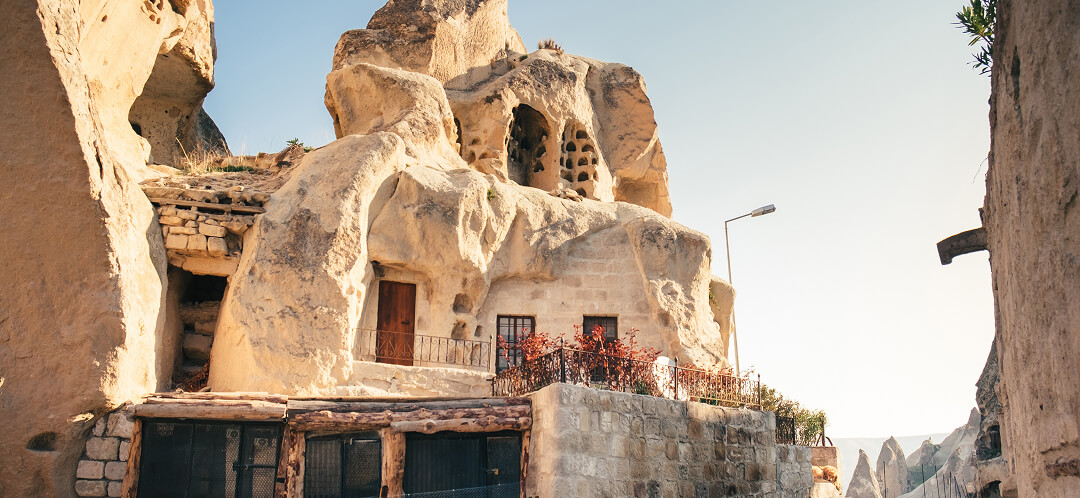
Cappadocia’s landscape was shaped by ancient volcanoes, which deposited thick layers of ash that compressed over millennia into a soft, workable rock called volcanic tuff. Early Christian communities carved monastery complexes into it, while Cappadocian families lived inside it for centuries. The rock hardens when exposed to air, making hand-carved structures remarkably durable.
What is marketed as a “cave hotel” falls into three quite different categories.
- Genuine carved cave rooms
These accommodations deliver the strongest sense of place: irregular ceilings shaped by the natural rock, walls that show tool marks, limited daylight, and a mineral stillness unlike any standard hotel. If you value atmosphere over brightness and are comfortable in spaces with no natural light, these rooms may be the right choice.
- Restored dwellings and heritage stone rooms
These rooms often strike the most satisfying balance. They occupy former homes or local mansions and retain original walls, arched ceilings, and regional character while offering better airflow and a more familiar layout. For many experienced travelers, this is the most considered choice: a strong sense of place, without the intensity of a windowless carved chamber.
- Modern cave-style rooms
These are comfortable and well-designed rooms, but they may not deliver the sensation of sleeping inside volcanic rock. Nevertheless, if your priority is a terrace, reliable climate control, and a smooth morning routine, they can still serve you well.
How a real cave room feels once you’re inside
First of all, a genuine cave room produces near-total darkness at any hour. At 6 am in July, when the sun has been up for an hour outside, your room remains completely black. Most guests find this disorienting on the first morning, as there is no gradual lightening or sense of morning arriving.
As volcanic tuff is also a natural insulator, cave rooms maintain a near-constant internal temperature of approximately 55°F to 60°F (13°C to 16°C), depending on depth, heating, and renovation. When the valleys reach 95°F (35°C) in July, the cave may still feel cool enough for heavy blankets. In winter, when temperatures drop below freezing outside, the cave holds warmth.
The silence inside is just as distinct. With rock surrounding the room, any sound feels absorbed: you hear less hallway noise, less street sound, and less mechanical hum than in a conventional hotel.
This experience is not for every traveler. Some find rooms without windows claustrophobic. If you want cave authenticity but need daylight, look for properties offering hybrid rooms with cave-carved interiors that open onto an external terrace.
Where to stay: Göreme, Ürgüp, or Uçhisar?
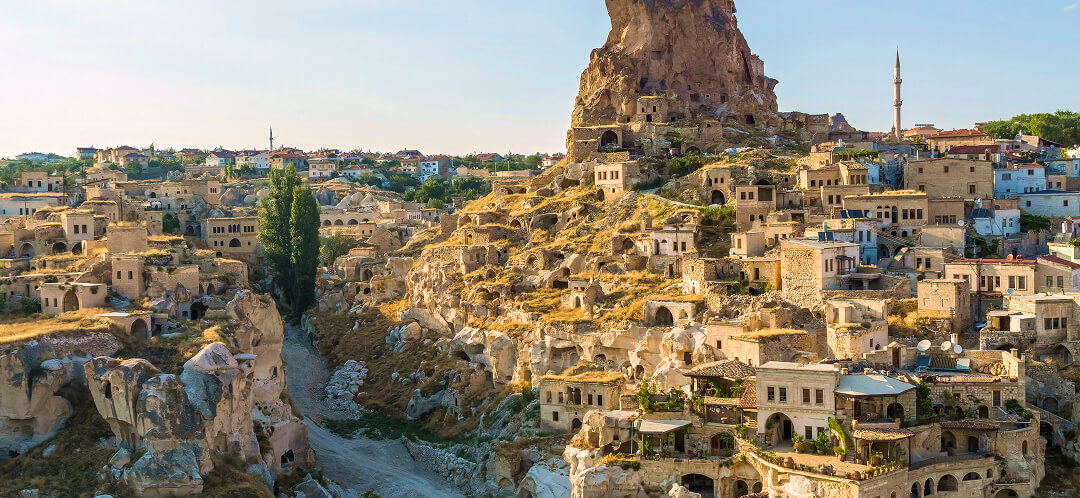
The villages of Göreme, Ürgüp, and Uçhisar form the heart of Cappadocia’s cave hotel landscape. Located close to one another, they offer different experiences and price points. Within each, the type of room is as important as the village itself.
Göreme
This is the region’s tourism center, positioned closest to the balloon launch fields. It hosts the Göreme Open-Air Museum, a vast, UNESCO-listed monastic complex carved directly into soft volcanic rock. Göreme has the highest concentration of cave hotels per area.
A useful benchmark here is Sultan Cave Suites. Most of its rooms are genuinely carved into the hillside, with original cave walls preserved beneath a layer of modern comfort. As of July 2026, a balloon-view suite costs approximately $300 to $850 per night, depending on room and terrace category.
Ürgüp
Ürgüp is larger and feels more like a town, with a strong hotel scene, better restaurants, and closer access to local wineries and vineyard areas. Those vineyards are worth the attention: the region’s native Emir grape produces a mineral-forward white wine that most visitors have never encountered elsewhere.
Here, Kayakapi Premium Caves, set within a restored historic neighborhood and home to the region’s only Michelin-starred restaurant; the hotel offers genuine carved-cave suites cut directly into the cliffs. The rooms are typically priced from $400 to $1500 per night, depending on whether it includes a private pool or terrace.
Travelers who prefer heritage stone architecture over carved rock should note that some of Ürgüp’s most acclaimed properties, including the restored eighteenth-century mansion Sacred House, are stone houses, not caves. Either category suits travelers pairing their stay with food and wine, or those who want character without sacrificing comfort.
Uçhisar
The entire village centers around Uçhisar Castle, a massive, hollowed-out rock mountain riddled with tunnels and ancient rooms. From the highest point in Cappadocia, it offers wide views across the surrounding valleys. The village has fewer hotels than Göreme or Ürgüp, but houses some of the region’s most architecturally significant properties, with prices that reflect the setting.
At Museum Hotel, a Relais & Châteaux property whose 34 rooms are carved into the tuff cliff face, a Deluxe cave room starts at about $620 per night, while the top suites with private terraces or plunge pools reach well over $1,500.
Nearby, Argos in Cappadocia, built into a restored thousand-year-old monastery, mixes genuine cave rooms with restored stone mansions across its seven buildings, generally running from $550 to $1,800 per night depending on which type of room you book.
Choose the village based on the kind of stay you want, not its positioning. If this is your first visit and you want easy tour pickups, restaurants, and the classic balloon-and-terrace image, Göreme is the most practical location. If you prefer a calmer town, better dining, and a more polished boutique hotel, Ürgüp will likely feel more comfortable. If you want quiet, open views, and a more refined hotel setting, Uçhisar is usually the strongest choice.
Our convenient hotel search tool can help you compare options and find the right property for your trip.
Before you book: match the room to your sunrise plan
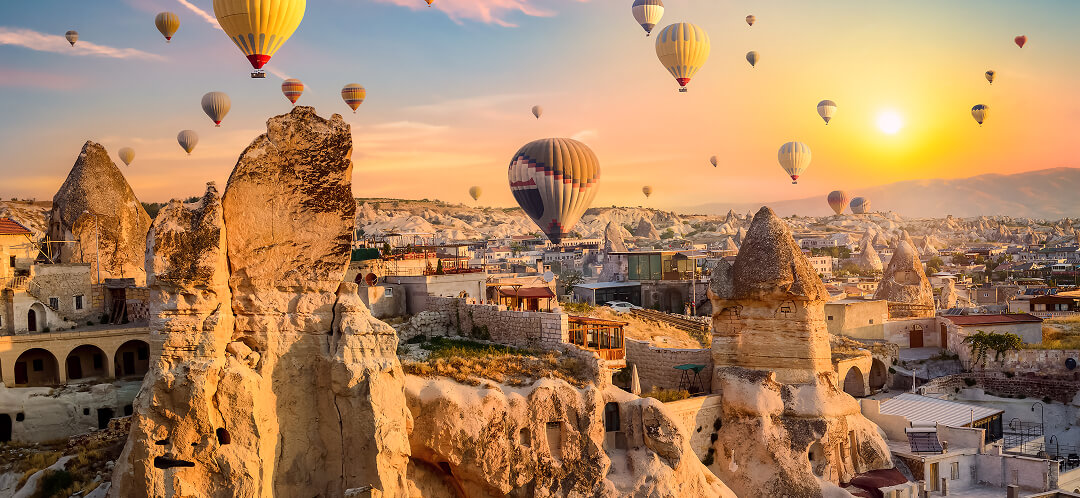
In Cappadocia, the day’s defining moment happens at dawn. The balloons fly at first light, when hundreds lift off together over the valleys, and it is the sight that draws most travelers here in the first place. That makes one question more useful than any other before you book: at sunrise, will you be up in a balloon, or watching from the ground? Your answer should decide which room you choose, and settling it in advance saves you from discovering the mismatch after you arrive.
Balloon flights depart about an hour before sunrise, with hotel pickups beginning at about 4:30 am. That timing has a direct bearing on which room serves you best.
- If you are flying, a genuine cave room without windows is an asset, as total darkness before a pre-dawn alarm means undisturbed sleep until the moment you need it.
- If you are watching from the hotel, the terrace question becomes the most important one you can ask. A private terrace with an unobstructed valley view at dawn will serve you better than the deepest cave suite.
- If you want both, plan at least two or three mornings. One for the flight, and one for watching. It also gives you time to actually experience the room, which travelers on tighter itineraries consistently miss.
With that frame in mind, check these details before confirming any reservation:
- Is the room a carved cave, heritage stone, or cave-style? Reputable properties describe this clearly. Vague responses like “our rooms have a cave feel” are not worth much.
- What does the ceiling look like in the listing photos? Irregular, asymmetrical surfaces indicate genuine carving. Smooth, uniform arches almost always suggest construction.
- What kind of outdoor access does the room have? Private terrace, shared rooftop, or no outdoor space are three meaningfully different situations. Hotel galleries typically show the most dramatic angle of the property, not the actual view from every room category. Ask specifically about yours.
- How deep into the rock does the room go? An alcove room and one extending 30 feet or more (9.5 meters) into a hillside are both marketed as “cave rooms.” The difference in experience is significant.
- How do you reach the room? Some cave rooms involve uneven stone steps or sloped paths. After a long transatlantic journey, or if you have mobility issues, ease of access matters a lot.
- Is the property registered as a historic structure? Some of the region’s most authentic hotels hold cultural heritage designation from the Turkish Ministry of Culture, a reliable indicator of genuine age.
In reviews, look for specific sensory language: “dark,” “cold,” “quiet,” “mineral smell.” Words like “nicely decorated” or “modern and comfortable” often signal a property that has prioritized aesthetics over authenticity.
How to get to Cappadocia from the US
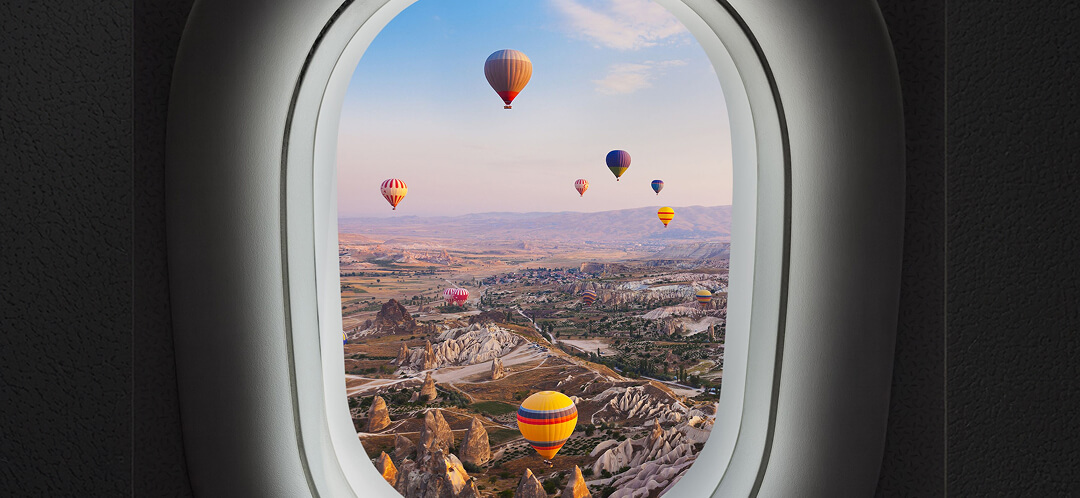
Since there are no direct flights from the US to Cappadocia, most travelers fly through Istanbul Airport (IST), usually with Turkish Airlines, and continue on the same itinerary to Kayseri Erkilet Airport (ASR) or Nevşehir Kapadokya Airport (NAV). From either airport, a prearranged hotel transfer or private car takes you to Göreme, Ürgüp, Uçhisar, or another Cappadocia village.
Flights from the East Coast
From the East Coast, the most convenient gateways include New York John F. Kennedy International Airport (JFK), Boston Logan International Airport (BOS), Washington Dulles International Airport (IAD), and Miami International Airport (MIA). The nonstop flight to Istanbul Airport (IST) usually takes approximately 10 to 12 hours, and the domestic flight to Cappadocia adds approximately 1.5 hours to the trip.
As of July 2026, a business-class round trip from New York (JFK) to Kayseri Erklet Airport (ASR), via Istanbul, commonly ranges between $5,400 and $8,500, with fares varying by date and connection time. Most East Coast travelers can continue to Cappadocia the same day and arrive in time for a first evening in the village.
Flights from the West Coast
From the West Coast, the trip requires a longer first leg. Flights from Los Angeles International Airport (LAX), San Francisco International Airport (SFO), or Seattle-Tacoma International Airport (SEA) usually take approximately 14 to 15 hours to reach Istanbul Airport (IST).
A business-class round-trip from a hub like Los Angeles International Airport (LAX) to Nevşehir Kapadokya Airport (NAV) costs about $6,200 to $9,500. For most West Coast travelers, an overnight stop in Istanbul before the onward domestic connection is a more convenient approach, particularly when the following morning involves a pre-dawn balloon pickup.
Kayseri or Nevşehir: where to fly?
Kayseri Erkilet Airport (ASR) often gives travelers more flight options. Nevşehir Kapadokya Airport (NAV) is closer to the main Cappadocia villages and can shorten the ground transfer. The better airport depends on the arrival time, hotel location, and how much transfer time you want after a long journey.
Whichever airport you choose, arrange your transfer before arrival. Cappadocia’s villages are not located directly beside the airports, and a prearranged transfer makes the final part of the journey smoother.
Final Thoughts
The most rewarding Cappadocia stay comes from planning the details most travelers leave to chance. The room you book shapes how the landscape feels in private, before the terraces fill and before the balloons rise, and the journey that gets you there shapes how well you arrive to enjoy it. Both deserve the same attention, and both are easier to get right when you plan them early.
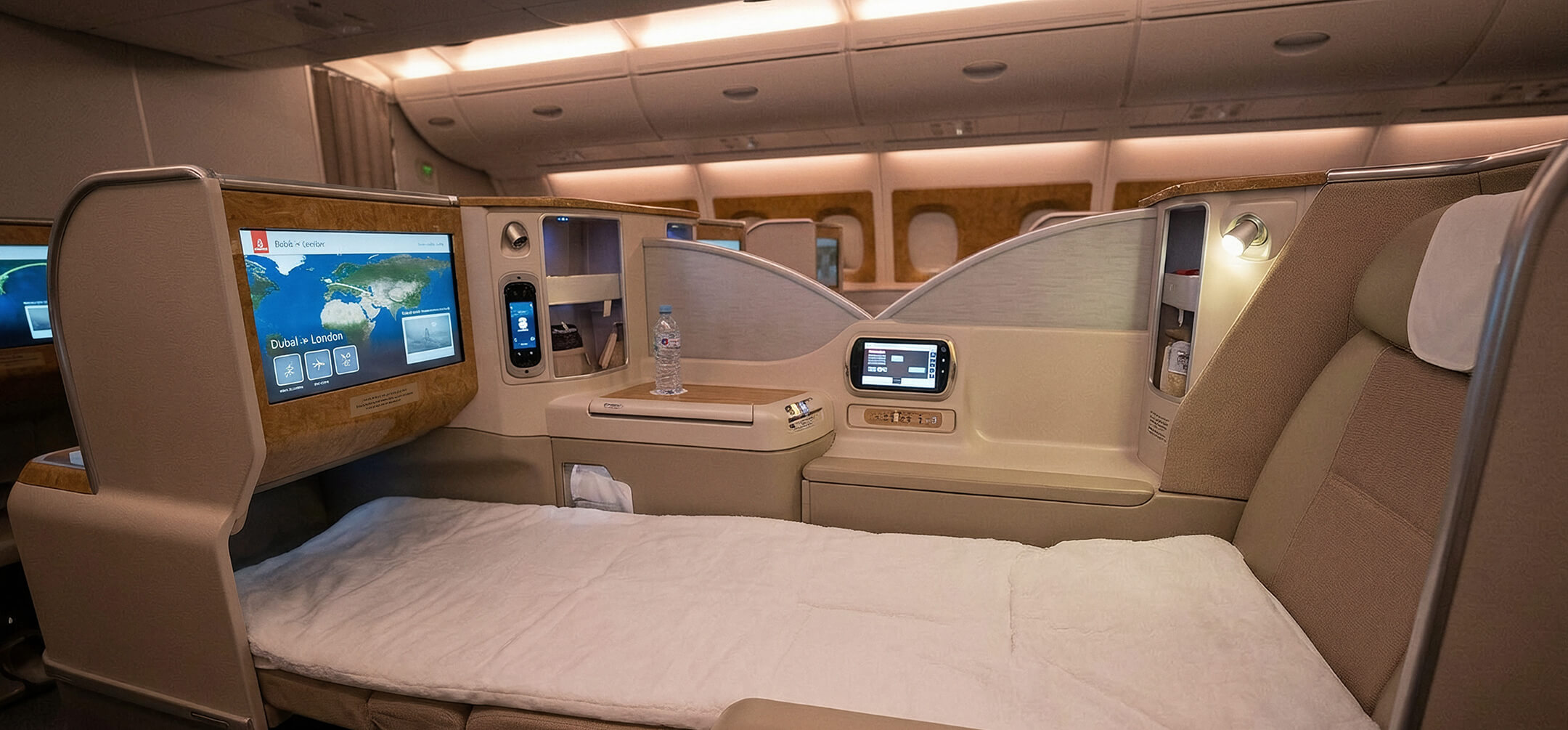
At AranGrant, we can help make this itinerary easier to plan from the start. You can book your business-class flight and receive guidance on aircraft selection, seat configuration, and connection timing. Whether you are flying from the East Coast and continuing directly to Cappadocia the same day, or routing from the West Coast with an overnight stop in Istanbul, we will help you structure the journey so the travel itself is as considered as the destination.