
First class flights to Paris typically range from $16,000 to $24,000 round-trip from the US. This is based on cross-platform analysis across major booking tools. Unlike other cabins, pricing remains relatively stable across seasons, which already signals that this market follows a different logic.
First class is also becoming increasingly rare. Many major US carriers, including Delta Air Lines, United Airlines, and American Airlines, have scaled back or removed international first class altogether. What remains is no longer a mass-market product, but a highly selective offering. Here’s how first class to Paris actually works in 2026.
First class flights to Paris typically cost $5,000 to $10,000 for connecting itineraries and $16,000 to $24,000+ for nonstop flagship cabins. Prices vary more by routing and airline than by season.
Table of Contents
Next in the series: Best Luxury Travel Accessories for Him and Her in 2026
First class flights to Paris: what to know before we dive deeper
Only a handful of airlines still offer a true international first class experience on this route, and availability (especially on nonstop flights) is tightly controlled. At AranGrant, we see the same pattern when helping clients explore premium options. Interest in first class flights to Paris remains strong, but understanding what drives these prices is key.
First class supply is extremely limited. On aircraft with true first class, there are often just four seats, compared to 40 to 60 in business class, meaning over 90% less inventory. That scarcity is intentional. First class is not designed to compete on price, but to maintain exclusivity.
That matters on Paris routes. Availability is limited, nonstop options are highly selective, and not every ticket labeled “first class” delivers the same experience. Some itineraries are genuine flagship products. Others are simply the least expensive way into the first-class fare bucket, often through a connection.
This guide focuses on what actually matters if you are considering first class flights to Paris: what they cost, which airlines still offer true first class, when the premium may make sense, and how to approach booking more strategically.
Next in the series: The world’s best airports in 2026: Skytrax top rankings
How much does first class to Paris cost?
Our route-by-route review shows a clear pattern: first class to Paris is not one price point and not one product. At the lower end, connecting itineraries from the US can start around $5,000 to $10,000 round-trip. These are most often routed through London and usually represent the market entry point rather than the most exclusive version of first class.
True long-haul first class booked through European hubs tends to sit in a more stable middle band of about $13,500 to $17,000 round-trip.
Nonstop flagship first class, especially on Air France, is where pricing moves into a different category altogether. In our checks, nonstop first class to Paris generally ranged from about $16,300 to $25,400, with a few higher outliers on certain routings and fare types.
What our pricing checks found by route
| US route to Paris | Entry-level connecting first class | True first via European hubs | Nonstop flagship first class |
| JFK to CDG | $5,000-$5,900 | ~$16,000 | $16,300-$17,900 |
| MIA to CDG | $6,900-$9,600 | ~$13,600 | $16,500-$21,700 |
| DFW to CDG | ~$7,000 | $13,500-$15,100 | no nonstop first class found |
| SFO to CDG | $8,500-$9,300 | ~$16,300 | ~$17,700 |
| LAX to CDG | $8,200-$9,800 | $16,100-$17,100 | $18,800-$25,400 |
| ORD to CDG | no low entry tier found | $15,800-$18,800 | no nonstop first class found |
A few things stand out immediately:
- New York gives the widest spread, from roughly $5,000 for connecting itineraries to nearly $18,000 for nonstop flagship first class in peak season.
- West Coast departures start much higher, even before you step into the very top tier.
- Some major US hubs, including Chicago and Dallas, do not consistently offer nonstop first class to Paris. In many cases, travelers are routed through European hubs such as London, Frankfurt, or Zurich instead.
Seasonality matters less than most travelers expect
One of the strongest patterns in our research was how little the price floor moved.
For JFK to Paris, the cheapest connecting first-class options stayed close to the same level across off-season (mid-November 2026), shoulder season (mid-September 2026), and peak summer (mid-July 2026). The nonstop premium moved more, but not wildly. In practical terms, that means seasonality changes convenience and availability more than it changes the starting price of first class.
That is very different from economy and often different from business class.
Last-minute vs early booking
First class does not behave like a typical sales market. Airlines are not usually trying to fill dozens of unsold seats at the last minute. Inventory is small, and the most desirable products are tightly protected.
From what we saw, the most useful window is generally about 2 to 4 months before departure for standard premium planning. For summer or holiday travel, it is smarter to look earlier. Last-minute booking can still surface options, but it becomes riskier if you care about a specific airline, nonstop service, or a true flagship first-class experience.
Google Flights can be useful at this stage because it is good for an initial price screen. It shows how the market is structured, which routings exist, and whether a nonstop premium is sitting in a completely different band from the connecting fares. But it is a screening tool, not the whole booking strategy. Once you understand the market shape, the next step is narrowing down what is actually worth buying.
Which airlines offer true first class to Paris?
Not every airline selling a “first class” fare to Paris offers the same level of product. This is where many articles blur together business, hybrid premium products, and genuine international first class. They are not the same.
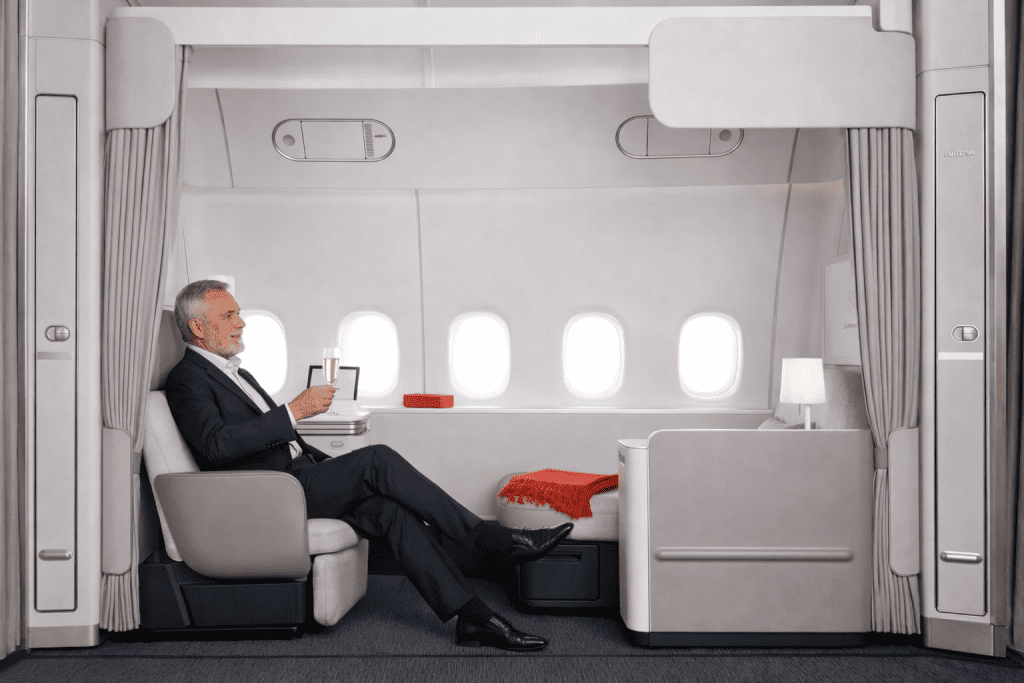
Air France La Première
For many travelers focused on Paris, this is the benchmark. It is the clearest example of true nonstop flagship first class on this market.
Based on our research across multiple booking platforms and routes, Air France La Première typically ranges from about $16,000 to $21,000 round-trip from the US (with some peak or high-fare availability reaching up to $24,000 or more).
Unlike lower-tier first class options, pricing for La Première remains relatively stable across seasons. The premium reflects not just the onboard product, but also limited availability, strong demand for nonstop routes, and a highly controlled inventory.
This is the option to watch if privacy, ground service, and nonstop convenience are all priorities.
Lufthansa First Class
Lufthansa remains one of the strongest true first-class options to Paris. But it usually appears via Frankfurt or Munich, not nonstop from the US to Paris. In our data, this tier was remarkably stable and often fell into the $13,500 to $17,000 range depending on origin and routing.
It is often a smarter comparison point to Air France than lower-priced connecting fares via London.
Emirates First Class
Emirates first class can appear on longer routes to Paris, typically via Dubai. It is one of the most refined first-class products in the industry. But it comes with a significant trade-off in travel time.
A typical US to Paris itinerary via Dubai can take 18 to 24 hours total, compared to about 7 to 10 hours nonstop or 9 to 12 hours with a single European connection.
In our research, these itineraries generally fall into the $18,000 to $25,000+ range round-trip, depending on routing and availability. That places them in line with, or above, nonstop flagship pricing, despite the longer journey.
For some travelers, the appeal is the onboard experience itself, rather than route efficiency. However, for a US to Paris trip, this option is usually less practical if your priority is a direct and time-efficient journey.
British Airways First
British Airways First appears frequently in lower-priced connecting search results to Paris, usually via London. In our research, these itineraries typically range from about $5,000 to $10,000 round-trip from the US, depending on departure city, routing, and season.
This is important because it often defines the entry point for first-class pricing. It also highlights a key distinction: the lowest-priced first-class ticket is not always the most exclusive version of the experience.
That distinction matters. In this market, a $5,500 first-class itinerary and a $16,500 first-class itinerary may technically sit in the same cabin category. But they deliver very different levels of privacy, service, and overall trip quality.

Next in the series: Luxury Beach Destinations: Summer 2026
First class vs business class to Paris, is it worth it?
This is where the decision usually gets real. For JFK to Paris, our comparison showed business class at roughly $3,900 to $5,500, while first class usually sat at $16,000 to $24,000+ depending on season and product. That means first class is often 2.5 to 4 times more expensive.
So the question is not whether first class is better. It is. The question is whether it is better enough for the way you travel.
What you get in business class
Business class on the major long-haul carriers already covers most of the comfort essentials that matter on a Paris flight:
- a lie-flat seat
- lounge access
- upgraded dining
- more privacy than economy
- priority airport handling
For many travelers, that already solves the real pain points of transatlantic flying.
What first class adds
First class usually adds:
- more personal space or a more enclosed suite
- a quieter cabin with far fewer passengers
- more attentive and individualized service
- stronger ground experience
- in some cases, chauffeur or escort-style handling
These upgrades are meaningful, but they are not proportional to the price jump.
The honest value equation
Based on our checks, business class often delivers most of the practical long-haul comfort at a fraction of the cost. The biggest leap in air travel comfort is usually from economy to business. The jump from business to first is more about privacy, exclusivity, and refinement than about basic comfort.
So is it worth it? It can be, if you care deeply about privacy, are celebrating something special, need the smoothest possible ground experience, or find a rare fare that compresses the usual gap. But for many Paris trips, business class is the rational buy and first class is the indulgent one.

Best routes from the US to Paris in first class
Not all US departure cities behave the same way. Route structure changes both price and product quality.
- JFK to CDG: This is the strongest first-class market in our review. It had the widest range of options, the clearest nonstop premium tier, and the most consistent availability structure. It is also the route where the contrast between connecting entry-level first class and nonstop flagship first class is easiest to see.
- LAX to CDG: Los Angeles showed much higher starting prices and a more expensive nonstop premium band. It also highlighted another important pattern: West Coast first class is driven more by distance, route structure, and product availability than by season alone. If you are departing from LAX, expect a much higher floor and less room for casual experimentation.
- ORD to CDG: Chicago was especially telling because it did not show a low-cost first-class entry band in the same way JFK did. That makes ORD a good reminder that some markets behave almost like “true first class only,” where you move straight into the $15,000-plus range.
- MIA, SFO, and DFW: Miami often sat between New York and Los Angeles in pricing. San Francisco showed that lower fares can come with extra complexity, including longer travel times and in some cases additional stops. Dallas confirmed that even large hubs may not reliably offer nonstop first class to Paris.
In other words, your origin city does not just affect price. It affects what “first class to Paris” really means.
Why aircraft and routing matter
Aircraft type matters because not every first-class cabin is configured the same way, and not every route carries the same product. Routing matters because some of the lowest fares exist only because the itinerary is less efficient.
That is why comparing one “first class fare” to another without looking at the route can be misleading.
Next in the series: What is a Mixed Cabin Flight?
How to find discounted first class tickets to Paris
Discounted first class does exist, but not in the way many travelers imagine. The best opportunities usually come from structure, not from a public flash sale.
Know the difference between cheaper and better
A lower first-class fare often means one of three things:
- a longer routing
- a connection through a dominant hub like London
- a product that is technically first class but not the most exclusive version available
That does not make it bad. It just means you should know what you are trading away.
Use mixed-cabin strategy carefully
Sometimes the best overall value comes from flying the long-haul segment in the premium cabin you care about and being more flexible on the shorter leg. If you are tempted by a lower fare, check whether the premium experience is actually on the transatlantic portion rather than only on a short feeder segment.
Reposition when it makes sense
If your home airport has weak first-class availability, repositioning can open better value. For example, the difference between a constrained hub and a stronger premium market can be substantial. That said, repositioning only works when the savings meaningfully exceed the extra time, risk, and complexity.
Stay flexible on airport pairings
One subtle pricing lever we saw was airport variation, especially on returns. Small changes in the airport pair can affect fare construction without changing the overall trip in a dramatic way.
Work with a team that understands premium fare logic
Some premium itineraries are not hard to find, but they are easy to misread. Others require a closer look at fare construction, routing quality, and whether the premium price is buying a genuinely better experience. This is where an experienced advisor adds more value than a simple search screen.
At AranGrant, this is exactly where we spend time: not just finding a first-class fare, but separating the impressive-looking option from the one that is genuinely worth booking.
Next in the series: Premium Airline Trends and Outlook 2026
When to book for the best availability
If you want flexibility, first class rewards earlier planning. For standard premium travel to Paris, 2 to 4 months ahead is a reasonable working window. If you are targeting summer, holiday periods, or a very specific nonstop product, earlier is safer.
What matters most is not chasing a mythical rock-bottom fare. It is giving yourself enough room to choose between:
- a true flagship first-class product
- a hub-routed first-class itinerary
- a business-class alternative that may represent better value
The closer you get to departure, the more likely the market becomes polarized. You may still see availability, but it can split into either less convenient routings or very high nonstop prices. That pattern showed up clearly in our peak-season checks.
Final thoughts
The Paris first-class market is smaller, more structured, and less seasonally flexible than many travelers expect. The lowest fares tend to stay in a narrow band. The real price spikes show up when you want nonstop service, stronger privacy, and a flagship product.
That is why the smartest way to shop first class to Paris is not to ask only, “What is the cheapest fare?” It is to ask, “What exactly am I buying for the premium?”
Once you look at the market that way, the route, the airline, and the booking strategy start to matter as much as the number on the screen.