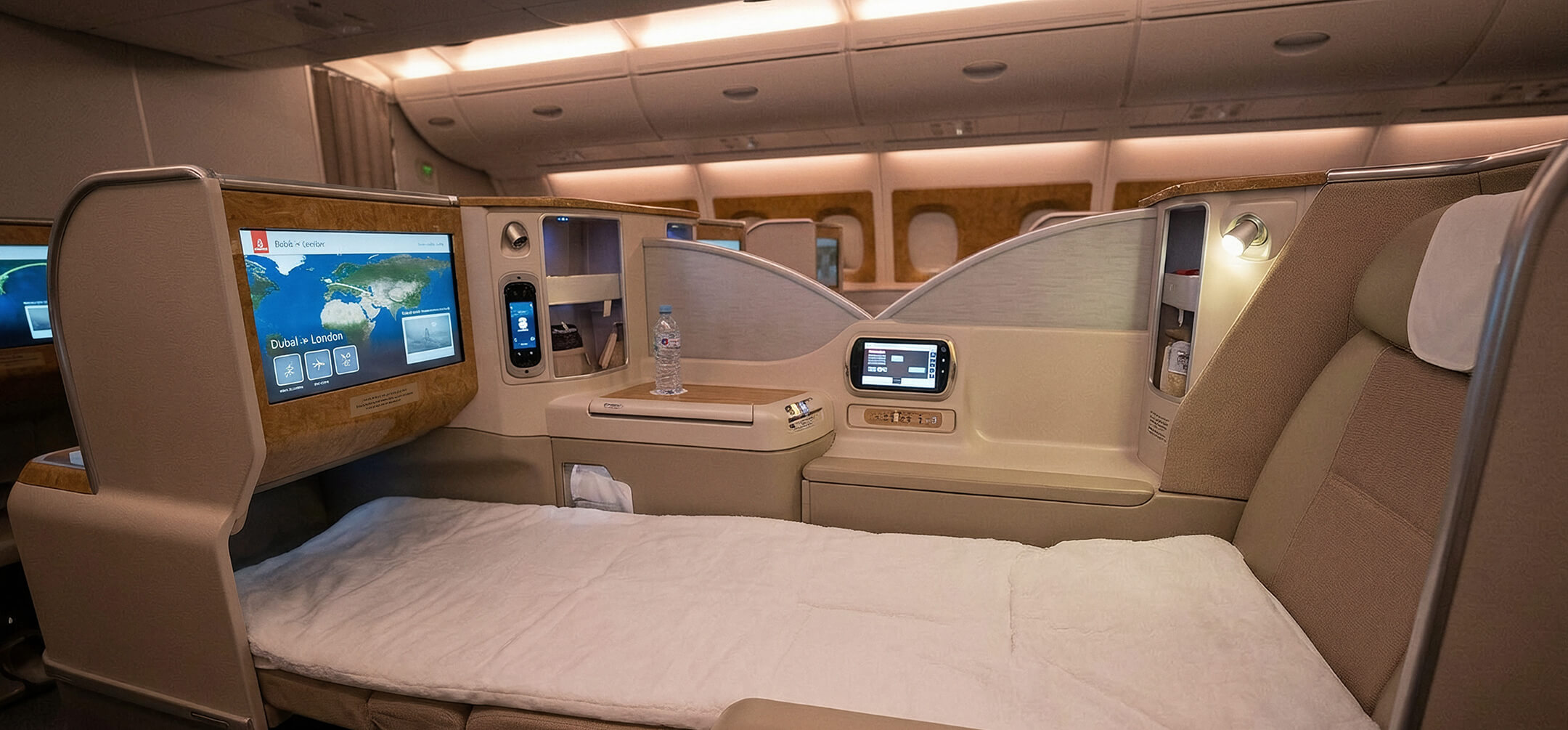
Business-class travel continued to gain momentum in the first half of 2026, especially on long-haul routes to Europe and Asia. Airlines kept investing in larger premium cabins, and more leisure travelers chose lie-flat seats for trips where sleep, privacy, and a better first day on the ground made a real difference.
The year did not pass without disruption, though, and events in the Middle East tested how resilient that premium demand really was. This article looks at where business-class demand ran strongest through the first half of the year, what forced travelers to rethink their long-haul plans, and what the rest of 2026 may hold.
Read in this post:
Where demand was strongest in the first half of 2026
What is fueling demand in Europe

Europe held its position as the most reliable premium travel region for Americans in the first half of 2026. The appeal is easy to understand. Many transatlantic flights operate overnight, flight times are manageable compared to Asia or Australia, and major routes offer frequent lie-flat service from several US hubs.
- American Airlines built its largest transatlantic schedule in company history for summer 2026. The airline now offers a record 18 daily flights between the US and Italy and Greece combined. That total includes a new nonstop flight from Dallas to Athens, operated by Boeing 787-8 aircraft. The planes feature lie-flat business-class seats. The airline also brought back year-round service between Miami and Milan after a six-year suspension.
- Delta Air Lines matched that scale with the largest transatlantic schedule in its own history. The carrier will run more than 650 weekly flights to nearly 30 European destinations this year. New additions include a New York–Malta route and the return of seasonal Catania service.
- United Airlines and JetBlue took a different approach, pushing premium comfort into smaller markets instead of major capitals. United Airlines added Boeing 767 service from Newark to Bari, Palermo, and Naples. JetBlue now operates 12 European routes, including a new Milan one. Most of JetBlue’s European network flies on Airbus A321LR narrowbodies fitted with 24 lie-flat Mint suites.
Within that expanded network, Rome and Milan remained the two most requested Italian cities among business-class travelers.
Rome rewards travelers with centuries of art and architecture around every corner, paired with a dining scene that turns a simple dinner into an evening event, an easy match for a traveler who just stepped off an overnight flight.
Milan draws a different kind of visitor, one who wants world-class shopping, elegant architecture, and a slower pace than Rome’s crowds allow.
Further south, the Amalfi Coast offers cliffside towns, private boat days, and sea views that feel worlds away from a boarding gate, while Santorini‘s whitewashed villages and caldera sunsets remain the destination many travelers picture when they imagine a Mediterranean escape.
What is driving growth across Asia

Asia gained notable momentum among Americans flying business class in the first half of 2026. Tokyo and Singapore continued to anchor premium travel across the Pacific, while Taipei recorded some of the most significant growth of any city in the region.
- Singapore’s role shifted in a concrete way this year.
United is rolling out its next-generation Polaris 2.0 business class across all 14 weekly Singapore-San Francisco flights starting in August, replacing the older cabin entirely on this route. Singapore Airlines has also posted record passenger numbers well above the industry average this year, a notable contrast to several European and Asian rivals that trimmed capacity in response to the Middle East conflict. - Taipei’s growth shows up clearly in the numbers.
Seat capacity between Taiwan and the US has grown at a compound annual rate of 12.8% since 2023, more than double the growth rate of the entire previous decade. Two-way seat capacity hit roughly 457,600 in January 2026 alone, up from about 421,400 a year earlier. EVA Air is driving much of this growth: the carrier launched its first-ever nonstop route to Washington Dulles in June, its eighth US gateway, flown on a Boeing 787-9 plane with 26 lie-flat business-class seats. - Airlines have also placed newer premium products on important Asia routes.
Cathay Pacific’s Aria Suite rollout, including service to Tokyo, shows where the airline expects sustained premium demand. For travelers, newer cabins mean more privacy, better storage, improved seat controls, and a more comfortable sleep setup on very long flights.
Tokyo, Singapore, and Taipei each draw a different kind of traveler within this shift toward Asia. Tokyo pairs ultra-modern neighborhoods with centuries-old temples, giving visitors a genuine mix of old and new within the same afternoon. Singapore offers immaculate infrastructure and a blend of Chinese, Malay, Indian, and global influences packed into one easily walkable city, along with some of the smoothest connections in the world for travelers continuing on into Southeast Asia. Taipei rounds out the trio with night markets, mountain day trips, and hot springs, all at a noticeably lower price point than Tokyo or Seoul.
What changed for travelers routing through the Gulf

The Gulf region typically accounts for a significant share of premium flights between the US and destinations across Asia and Africa, with Doha, Dubai, and Abu Dhabi serving as the primary transfer points for that traffic in a typical year.
Travelers passing through these hubs are used to a particular kind of layover: expansive lounges with sit-down dining and quiet rooms, fast immigration processing, and a high level of comfort that makes even a long layover a pleasant stop. That smooth experience made this year’s disruption stand out more than it might have elsewhere.
The conflict involving Iran disrupted regional airspace and long-haul connections through all three hubs. At the height of the disruption, Gulf flights saw widespread cancellations, reroutes, and rebookings, with Emirates, Etihad Airways, and Qatar Airways all adjusting significant parts of their operations.
For American travelers, the disruption also pushed some fares higher, driven by rising fuel costs and reduced flight options across the region.
This event was largely concentrated in the Gulf and did not stop Americans from traveling to Europe or Asia. It mainly made one slice of long-haul travel less predictable for a period of time. For anyone with a trip through the region later in 2026, it is worth keeping an eye on official travel advisories as conditions continue to evolve, building in extra connection time, and avoiding overly tight layovers.
What airlines are planning for the rest of 2026

Airlines kept building their schedules and cabins around premium demand even as the Gulf disruption unfolded. Several already announced changes point to how business class travel will look through the end of the year.
- American Airlines is expanding its Airbus A321XLR beyond its debut route. The New York–Edinburgh service launched in March runs seasonally through October 24, and the airline is shifting its Boston–Los Angeles route entirely onto the A321XLR by early August. American Airlines has signaled that additional international XLR routes will be announced as its winter schedule takes shape, extending lie-flat business class to routes where passenger demand is too low to fill a widebody aircraft.
- Cathay Pacific is taking its Aria cabin further into its regional network. Having introduced the suite on long-haul 777s serving San Francisco, Tokyo, and Milan, the airline plans to bring a related lie-flat product, branded Aria Studio, to its Airbus A330 fleet in late 2026, replacing older angled seats on shorter Asia routes.
- United Airlines, meanwhile, is not stopping at new aircraft deliveries. Beyond the Boeing 787-9s already flying its Elevated interior to Singapore and London, the airline plans to bring the same cabin to existing aircraft in its fleet.
Taken together, these moves show airlines treating premium demand as a long-term investment, and that investment is continuing despite the disruption in the Gulf.
Where ticket prices stand for the rest of 2026
Rising fuel and operating costs are pushing airlines to protect their margins on the most in-demand business-class routes.
As a result, carriers are holding prices steady or raising them on nonstop flights and peak summer departures to Europe and Asia, although some ticket prices dropped modestly earlier in the year on less popular travel dates and routes. Travelers should not expect the best business-class fares to become meaningfully easier to find before year-end.
How to book smarter for late 2026

If you are planning a business-class trip for the second half of 2026, focus on timing, airport choice, cabin quality, and reliability.
- Book earlier for Europe and Asia when your dates are fixed. Premium cabins on popular nonstop routes can fill quickly, and waiting often leaves fewer seat choices.
- Build in more connection time if your itinerary runs through Doha, Dubai, or Abu Dhabi. Gulf carriers remain useful for long-haul travel, but regional changes can affect schedules faster than travelers expect.
- Compare nearby airports. A departure from a secondary US gateway, or a layover through a different European or Asian hub, may give you better-priced tickets, a more comfortable cabin, or a more convenient arrival time.
- Look beyond the ticket price. A shorter layover, a true lie-flat seat, a better arrival time, or a more reliable connection can be worth more than a small fare difference.
- Use points and miles carefully. These are one of the most effective ways to reduce the cost of premium travel, but award seats on popular routes require planning and flexibility.
Thoughtful planning is one of the simplest ways to secure premium comfort at a smart value. At AranGrant, our travel advisors can help you compare routes, schedules, and cabins, so you can choose a business-class itinerary that supports the way you want to travel.